
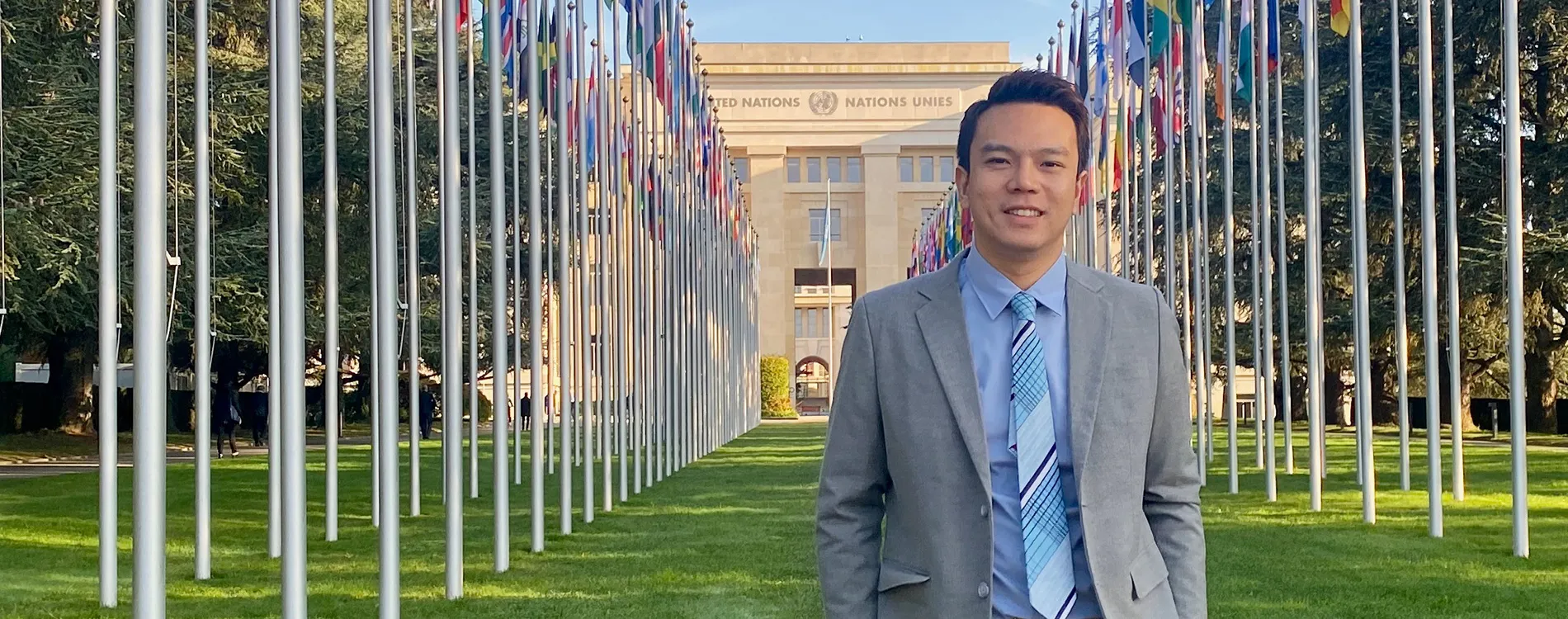
In November, Francis “Tom” Temprosa, LLM ’17, SJD ’26, assumed his role as a UN mandate holder on the UN Human Rights Council’s Working Group on the Use of Mercenaries. He is one of five independent experts who make up the working group. Based in the Philippines, Temprosa is the member from the Asia-Pacific region.
Temprosa was appointed following a competitive selection process. A consultative group reviewed a pool of candidates, and at its 63rd session in October, the council, composed of 47 UN member states, appointed Temprosa on the recommendation of the council president.
“We are tasked by the UN Human Rights Council to look at how mercenary and mercenary-related activities affect human rights,” Temprosa said.
“In a world rife with armed conflict, private military and security companies are also hired to provide personnel, weapons, and technology for operations,” he said. These companies’ use of guns and technology “may sometimes disregard the rules of armed conflict and lead to the most atrocious violations of human rights.”
The UN’s first special rapporteur on mercenaries initially examined how the use of mercenaries affect people’s right to self-determination. When the UN established the working group, the group’s mandate included monitoring how private military and security companies’ activities affect human rights, Temprosa said.
One definition of “mercenary” in international law requires that a person be specially recruited to fight in an armed conflict and be motivated chiefly by private gain—essentially soldiers of fortune, he explained. “The expanded work of the group also includes predatory recruitment, in which recruiters exploit people’s socioeconomic status or other vulnerabilities to draw them into mercenary activities, sometimes through coercion or fraud.”
At issue are human rights concerns both in the communities that are directly affected by conflict and among the people drawn into fighting, Temprosa explained. This includes the self-determination of peoples and the rights of people who have been subjected to predatory recruitment.
The working group engages with governments and affected communities, conducts country visits, identifies emerging issues and their impact on human rights, and submits reports to the UN Human Rights Council and the UN General Assembly. “Most importantly, we recommend measures to prevent abuses and human rights violations—and how to strengthen accountability,” he said.
Around the world, human rights violations have raised questions about oversight and accountability for mercenaries and private military and security companies implicated in such abuses. When people are recruited or hired for military or security operations, “it’s difficult to determine who exercises control, who is responsible for the abuses, and how the victims can obtain justice,” Temprosa said.
The group holds sessions with member states, international and regional organizations, national institutions, UN entities, nongovernmental organizations, academics, and other stakeholders.
Building on previous human rights work
The working group is the next step in Temprosa’s career path in international law and human rights. Since earning his JD in 2010, he has worked with the UN High Commissioner for Refugees and served as director of the Commission on Human Rights of the Philippines.
He teaches public international law and human rights at the Ateneo de Manila University School of Law in the Philippines and the Philippine Judicial Academy. He also serves as regional director of the Anti-Death Penalty Asia Network.
At Michigan Law, Temprosa’s SJD research examined UN commissions of inquiry, including “how international institutions assess evidence of human rights and international law violations and how they reach conclusions in very difficult circumstances,” he said. He sees this research as closely connected to the working group’s mandate. “I am really looking forward to bringing that lens into this work.”
Temprosa said he is particularly grateful to Professor Steven Ratner, his dissertation adviser, for his guidance, as well as that of Professors Christine Chinkin, Karima Bennoune, and Bruno Simma.
“Michigan gave me the space, and the professors at Michigan gave me the guidance, to really examine difficult questions in international law, and they have allowed me to develop an expertise that has allowed me to take on this role,” he said.
“The trust and the opportunity that Michigan gave me is just second to none,” Temprosa said. “We have a stellar cast of international law professors who have UN experience. I am really honored to follow their path.”
“Tom’s commitment to public service has been clear and consistent since he was an LLM student,” said Ratner, who is the Bruno Simma Collegiate Professor of Law. “He follows a long tradition of outstanding Filipino graduates, including Maria Lourdes Sereno, who served as her nation’s chief justice. We’re immensely proud of Tom’s achievements in the cause of human rights and international law.”