
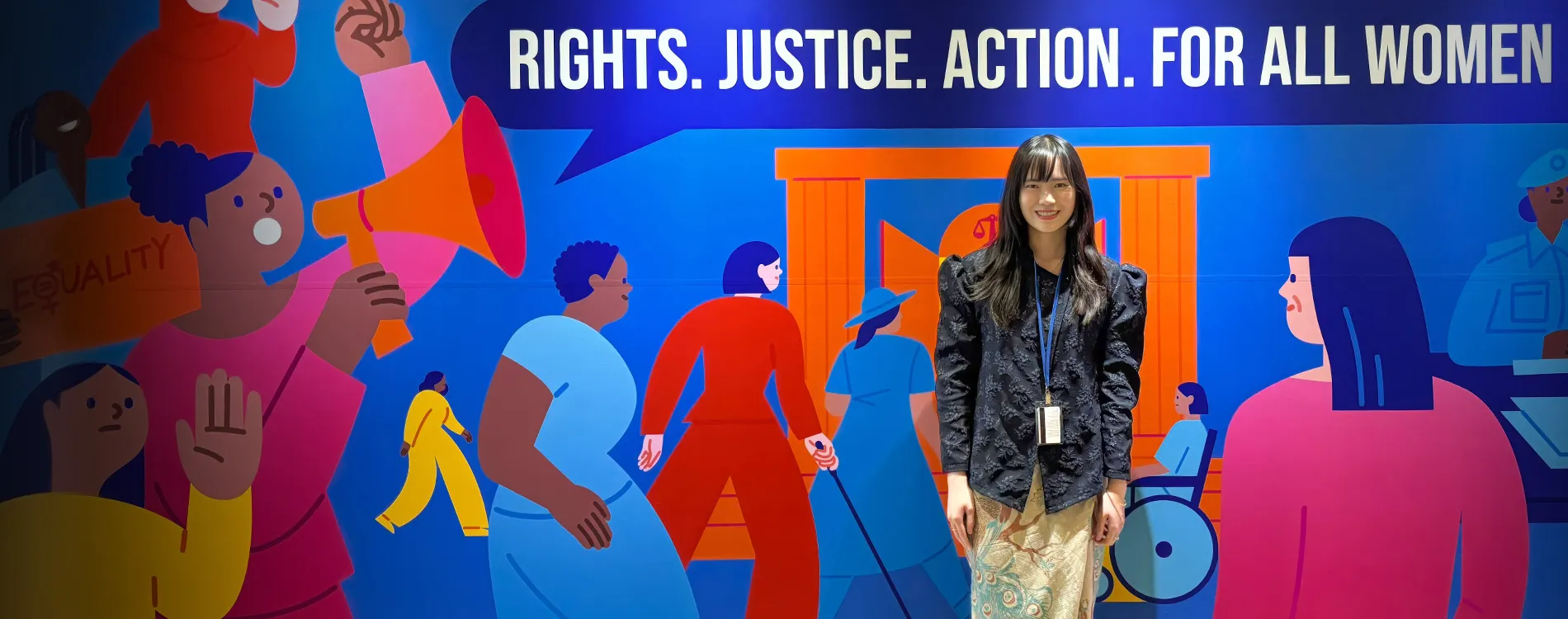
At the 70th session of the Commission on the Status of Women (CSW), held at the United Nations headquarters in New York in March, SJD student Debora Gunawan, LLM ’25, gained a deeper understanding of what meaningful progress on women’s rights requires.
The conference also provided insightful information for her research on violence against women. “My SJD project looks at how international standards on rape and violence against women are translated, resisted, or reshaped in domestic systems, particularly in Southeast Asia. CSW gave me access not only to legal and policy developments but also to the lived politics around them,” she said.
For example, “Across the sessions I attended, there was a strong focus on access to justice in practice, how institutions can fail survivors, how gender stereotypes shape decision-making, and how accountability mechanisms can be strengthened. Those are exactly the kinds of concerns that my research is addressing.”
Debora attended CSW as an observer for the American Society of International Law (ASIL). Her SJD committee chair at Michigan Law, Professor Karima Bennoune, ’94, suggested that she attend to connect with country representatives and others who may be helpful in her field research.
Bennoune is vice president of ASIL and co-chaired its 2026 meeting. When the society’s Women in International Law Interest Group issued a call for observers at CSW, Debora applied and was accepted.
CSW illuminated the breadth of the women’s rights field, as well as the connections among various parts of it, she said. “I went in already focused on violence against women and its international law operationalization, but CSW made me see how deeply connected these issues are to family law, economic justice, digital harms, harmful traditional practices, institutional culture, and even budgeting and data systems.”
Broad collaboration
“One of the clearest lessons for me was that progress for women requires a whole-society system of collaboration, from the multilateral level to national institutions to grassroots actors,” Debora said.
For example, she attended a session on ending female genital mutilation (FGM), hosted by the government of Liberia. The issue is not as simple as making the practice illegal, because FGM sometimes persists even when it’s outlawed. In some communities, women who have not undergone female genital mutilation may face social exclusion, including barriers to marriage, Debora explained. “This is why it is important for governments to engage grassroots and cultural actors to promote changes.
“You have to see this as a human rights problem that requires both men and women to work together.”
In another event on conflict-related sexual violence, prosecutors and practitioners talked about the need for transnational support, “because many prosecutors are overburdened, isolated, and handling deeply complex cases without enough expertise,” she said.
An international database that is helping to connect prosecutors and investigators globally was launched at CSW. This network, Debora said, “was presented as an infrastructure for accountability. It was very useful for prosecutors to access comparative jurisprudence and strengthen accountability mechanisms.”
Backlash to gender equality
Multiple speakers talked about the growing narrative of gender equality being framed as an ideology, “when it should be understood as a human rights issue grounded in the Universal Declaration of Human Rights and as an issue that affects society as a whole,” Debora said.
She noted that this backlash to gender equality is “intense and growing internationally, producing moral panic, political deadlock, and resistance even to long-established commitments. That made clear to me that advancing women’s rights today requires not only conviction but also the right strategy.”
Debora said she was glad that attendees spoke openly about backlash and institutional fragility. “The struggle is no longer only about advancing new norms. It is also about defending existing ones from rollback.”
The CSW’s agreed conclusions, typically adopted by consensus, were adopted by recorded vote of 37 to 1, after efforts to reach consensus failed. “That says a great deal about the political moment we are in,” Debora said.
A road to practical solutions
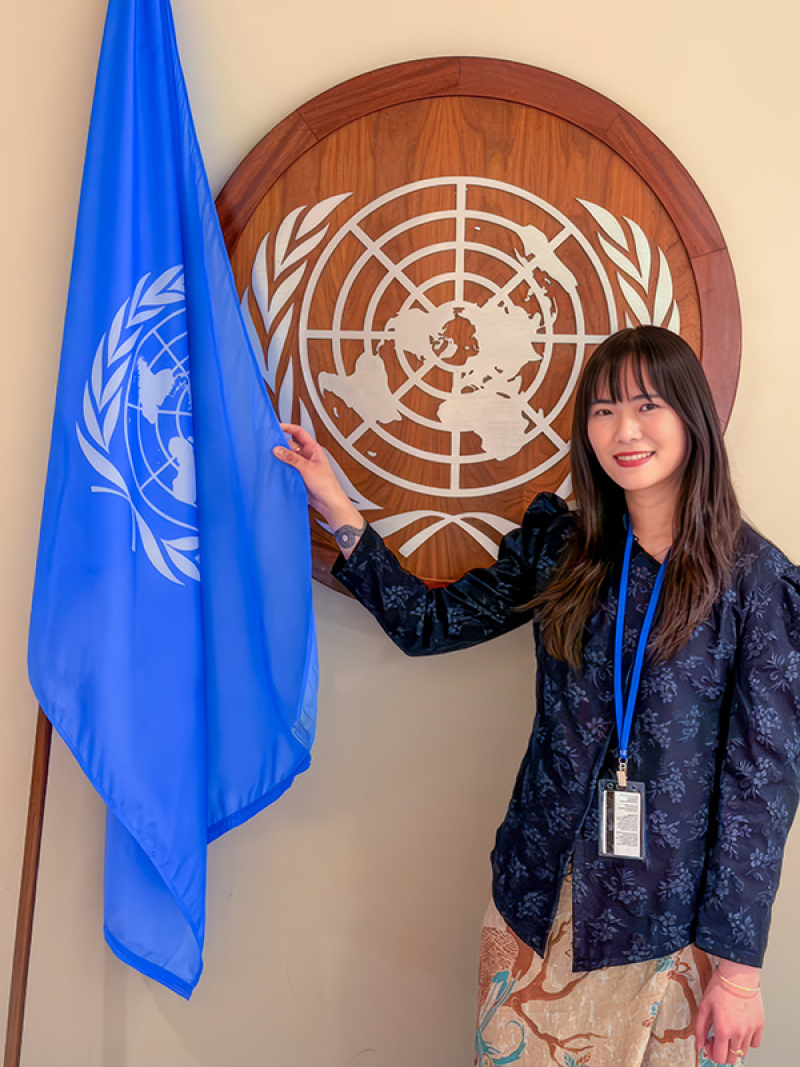
CSW participants discussed not just rights in theory but also specific problems and approaches that are working on the ground. These included gender training for judges, specialized courts, online harms legislation, and data on sexual violence.
“The conference went beyond abstract ideas. Countries and institutions were presenting actual mechanisms, data, and implementation models,” she said. “It was international law, but in a very grounded and human way.”
She hopes to attend future CSW conferences.
“I want to build a career as a feminist international law scholar. Being in a space where scholars, UN actors, judges, NGO advocates, and state representatives are all actively shaping these debates is important for me, both as a researcher and as someone who wants to contribute to those conversations over time.”