
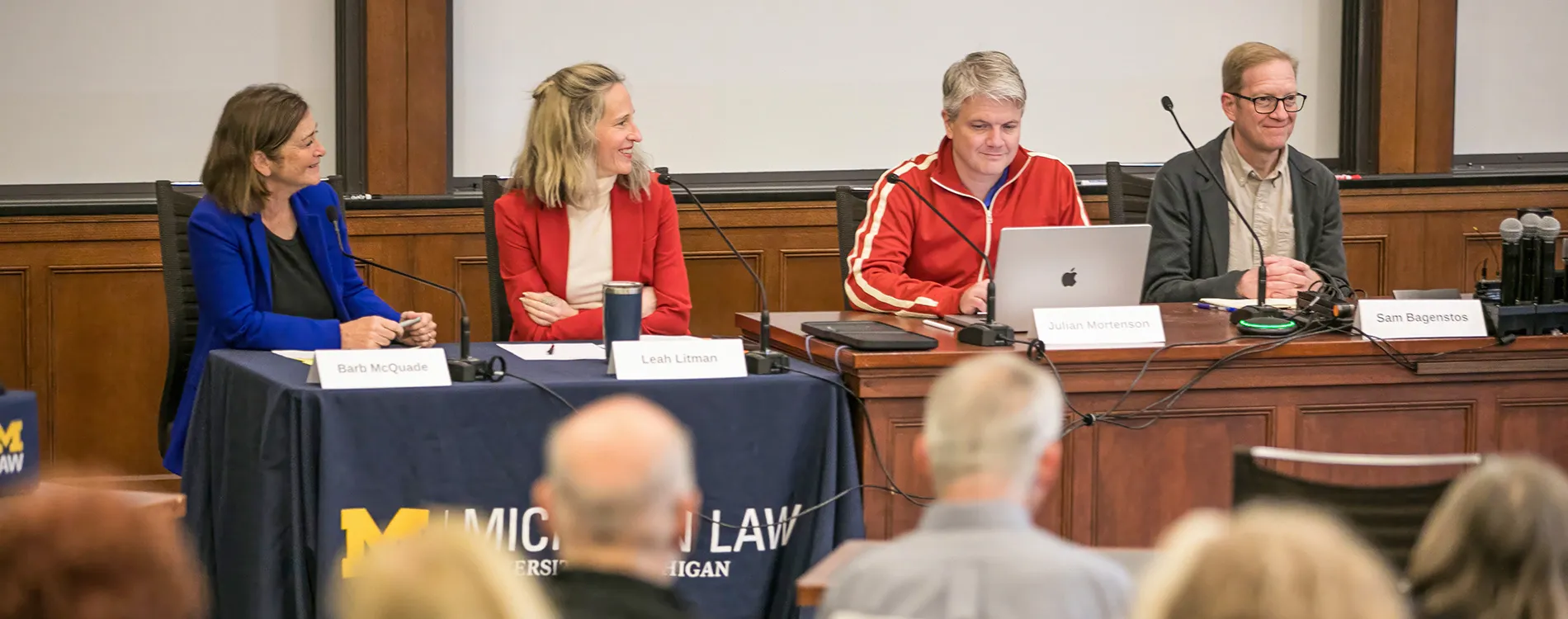
Michigan Law Professor Barb McQuade recently moderated a panel with Professors Sam Bagenstos, Leah Litman, and Julian Davis Mortenson on “Emergency Powers and the Election.”
They delved into ways that so-called emergency powers might be invoked to interfere in the upcoming midterm elections.
The panelists discussed some of the possibilities for election interference that worry them, what might happen in certain instances, and what safeguards are in place.
Here are four takeaways.
1. The ways the executive branch might invoke emergency powers to interfere with the election are uncertain.
McQuade, ’91, pointed out that the president has said he regrets not seizing voting machines after the last election, and she questioned what emergency measures a president could take, such as canceling the election and seizing ballots.
“I think there’s an ambiguity in the word ‘could’ that’s really important there. Could, in the factual, predictive sense, a particular president purport to have authority to do something and then try to do something?” Yes, said Bagenstos, the Frank G. Millard Professor of Law. “We are increasingly seeing a motivation in the executive branch of: We’re just going to act, and if somebody’s going to tell us to stop, we’re going to wait for them to tell us to stop.”
However, “Would some kind of emergency declaration give the president authority to do those sorts of things when the president wouldn’t otherwise have that authority?” No, Bagenstos said. “There is no authority simply to seize ballots or to seize voting machines.”
And if search warrants are used to collect ballots, for example, “There has to have been some magistrate who signs off on that search warrant. They have to find probable cause that there’s going to be some evidence of some crime that could be found if the search warrant is executed, so there is some independent check,” Bagenstos said.
McQuade asked whether the president could legally cite national security threats to deploy the National Guard, for example.
“There are ways to use legal categories that push the boundaries of plausibility but still speak the language of law such that it appears, especially to otherwise sympathetic listeners, that what you’re doing is likely authorized by the laws that you’re purporting to uphold—even though that’s not actually what’s happening,” said Mortenson, the James G. Phillipp Professor of Law.
On whether the courts might defer to the president if he cites national security, Mortenson pointed to National Guard deployments in Los Angeles and Chicago. When the lower courts addressed the administration’s claims to justify these actions, “I think most have done a pretty good job of actually diligently engaging with the claims that are made to them,” he said.
A bigger question is whether cases will require the Supreme Court to weigh in on factual questions, because “the Supreme Court has been inclined in lots of cases to look for ways to kick the can down the road,” Mortenson said.
The panelists discussed the possibility of federal immigration law enforcement agents showing up at polling places.
“The president has substantial powers over law enforcement,” said Litman, ’10, associate dean for faculty and research. Even though higher-profile efforts in certain cities have died down, “the actual numbers of immigration enforcement are up.”
As such, Litman said, “I think there is, reasonably so, a background fear about what the escalated presence of federal law enforcement might do as far as suppressing some communities’ willingness to go out and vote.”
However, she said, “There’s going to be more difficult questions if the president is ordering federal law enforcement to do things that actually restrict voting.”
2. Election monitors may assuage fears but also cause concern.
McQuade mentioned that when she was US attorney, election observers came out to make sure polling places were handicap accessible or that language translation was being provided. “The Justice Department has announced it’s going to send more than a thousand observers out to polling places this term. What about this idea of abusing people’s rights under the guise of enforcing civil rights law?” she asked.
Bagenstos explained, “The word ‘observers’ comes from the Voting Rights Act of 1965, which authorized the Department of Justice and the federal government in general to send out observers to then-covered jurisdictions…. And those observers had special access essentially behind the ropes in the polling place to make sure that nothing fishy was going on.”
But, since the Supreme Court’s 2013 Shelby County decision, “that authority as a practical matter no longer exists,” he said. Instead, the DOJ sends monitors to polling places, “but they have no more rights than anyone off the street would have…. They have to not interfere with anybody who is trying to vote or anybody who is trying to do their job.”
“Their actual legal authority is to watch and write stuff down. Do they stick with that, or do they instead interfere with people voting? Do they act in a way that intimidates potential voters?… Do they start asking people about their immigration status?” They’re not entitled to do any of that in a polling place, Bagenstos said.
3. States have authority over elections, but Congress can step in.
States have primary authority over elections, including those for federal office, but Congress can step in if it wants to—and it has in certain instances, Litman said. This has included setting a date for federal elections and, through the 15th Amendment, prohibiting discrimination in voting on the basis of race and allowing for enforcement.
Congress could confer some authority on the executive branch or agencies such as the US Postal Service, Litman said. But “Congress did not give the Postal Service the authority to just set rules regarding federal elections and nullify state laws regarding absentee ballots in particular.”
When the president issued an executive order under which the Postal Service would have declined to deliver entire batches of ballots if they did not comply with the federal government’s preferred procedures, the Supreme Court did not allow it, she said.
4. There’s reason for concern but also for hope.
Mortenson said he worries that “An ethos of law abidingness—basically of good faith and internal integrity among government officials in carrying out and implementing legal authorizations and respecting legal restrictions—seems to me to be very significantly eroded in ways that manifest in decisions made by people at the very highest levels of authority.”
When lower courts, both federal and state, have addressed these sorts of issues, they “have behaved admirably when faced with this kind of onslaught of lawlessness,” Litman said. “They have acted quickly, they have issued well-reasoned opinions under the circumstances, and they have held firm even in the face of really scary attacks on the safety of judges, sometimes, that are instigated by people in government.”
Bagenstos said that election officials are prepared for attempts to interfere and know what to do. “I find that state election officials tend to be pretty jealous of their prerogative to run elections, regardless of their party. I suspect and know from talking to a bunch of state officials that they will be prepared for these polling place monitors to overstep and then for the state officials to step in and make that stop.”
More generally, over the past couple of years, Bagenstos said he has seen “a civil society response that we care about our democracy in this country. What gives me hope is there are a whole lot of people who I might not agree with on a whole lot of political issues who will be really upset if something happens to try to take away people’s right to vote.”
Litman emphasized, “The president does not have authority over federal elections. DOJ and federal immigration officers do not have authority to challenge individuals’ ballots or stop them from voting. And I think the more people understand that is super important for a number of reasons. One is: It raises the political costs of any effort to actually try to interfere with the election.”
McQuade agreed. “The more the public knows about the limitations on executive power, the less likely the executive will do something that’s improper. So get out and vote and encourage your friends to do the same.”