
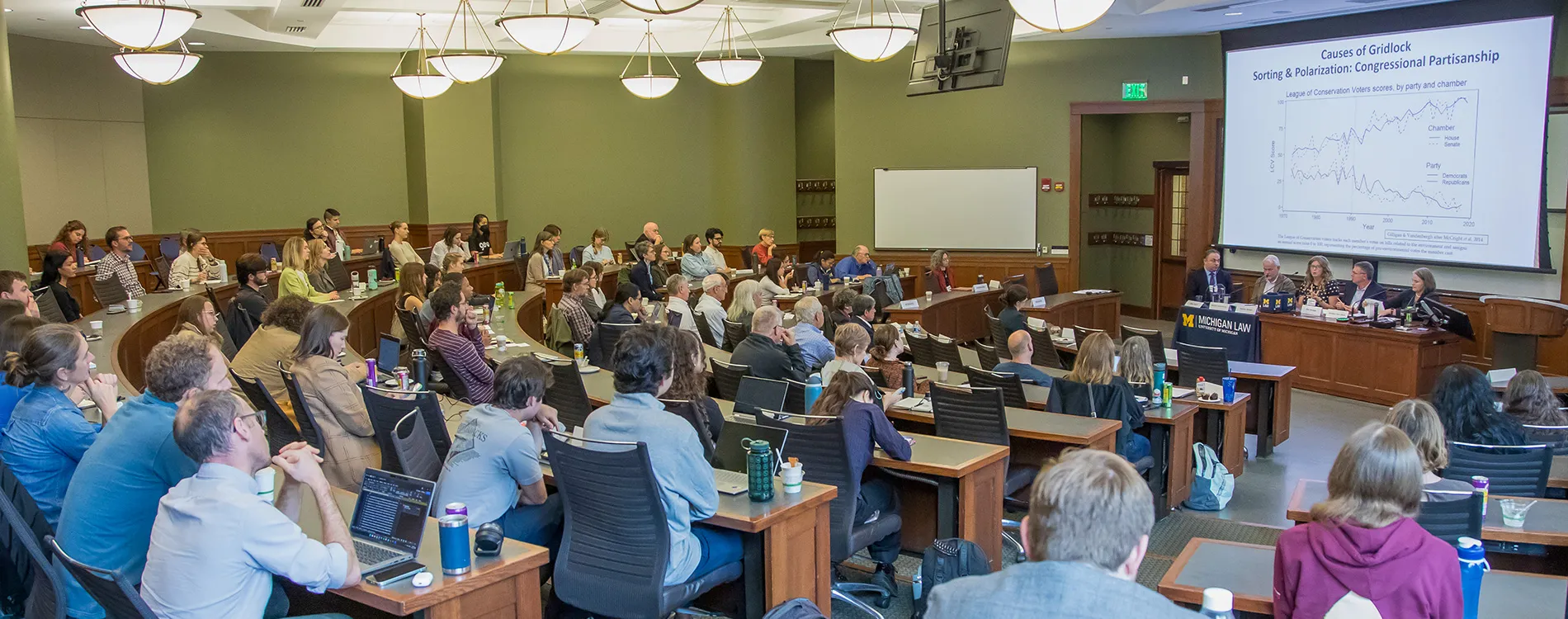
Although the federal administration has substantially cut back key environmental protections, other levels of government can still act to protect environmental resources and values, according to panelists at a recent Michigan Law conference.
The Environmental and Energy Law Program (EELP)’s conference, Responding to Federal Retreat: Reimagining Environmental and Energy Law in the Great Lakes Region, detailed how the second Trump administration has weakened and eliminated longstanding safeguards for air, water, species, and more—and also explored how states, cities, tribal governments, and other interested parties can push back.
Four panel discussions focused on issues of particular concern to the Great Lakes region—artificial intelligence (AI) and related data centers, environmental justice, the role of tribal nations, and water resources—while a keynote address from former US Environmental Protection Agency Regional Administrator Debra Shore took a broader overview.
“We were motivated by this combination of nonstop federal chaos and distinct challenges in the Great Lakes area,” Nina Mendelson, the Joseph L. Sax Collegiate Professor of Law and a co-director of the EELP, said in her closing remarks.
“We wanted to create an opportunity to gather and discuss and consider how to address our needs for clean air, clean water, clean energy, a healthy environment and wildlife habitat—because we have an irreplaceable natural environment, especially in our Great Lakes region. I’m really excited to continue these conversations to make meaningful progress on environmental energy law policy and policy.” Mendelson hosted the conference with her EELP co-directors, Alexandra Klass, the James G. Degnan Professor of Law; and Oday Salim, director of the Environmental Law and Sustainability Clinic.
Following are key points from each of the five sessions:
Better regulation of AI-focused data centers is on the table.
The first panel focused on AI issues—particularly the impact of the large-scale data centers that power the technology, sparking concern about water use, electricity demands, and noise. A controversial state tax break that has encouraged data center development in Michigan is now law, but panelists said avenues still exist to influence if, where, and how they are built.
State Senator Sue Shink, ’94, voted against the tax break and criticized how it was “shoved through” without adequately engaging with local governments. “The people of Michigan have never been more united against something in my life,” she said. “They’re afraid of what data centers are doing to their community. They’re afraid of what they’re doing to our electric supply, to climate change, and to water use.”
Yet she noted there are now 79 bills under consideration in the legislature to regulate data centers—“all the protections that should have been put in place before the tax breaks were given.” Actions the state government could take, she said, include eliminating nondisclosure agreements between developers and local officials; enforcing public hearing procedures; and requiring public disclosure of information about water and electricity use, which is generally lacking.
Several panelists mentioned the power of community benefits agreements that data center developers typically negotiate with local governments. Michigan Public Service Commission Chair Dan Scripps, ’05, said Michigan’s template for siting and permitting renewable energy projects could also apply to data centers.
“It’s designed to change the conversation from ‘What is being done to my community?’ to ‘How do I benefit from this if I make this choice?,’” Scripps said. “Then the community can make a more informed choice about whether the tradeoffs are worth it.”
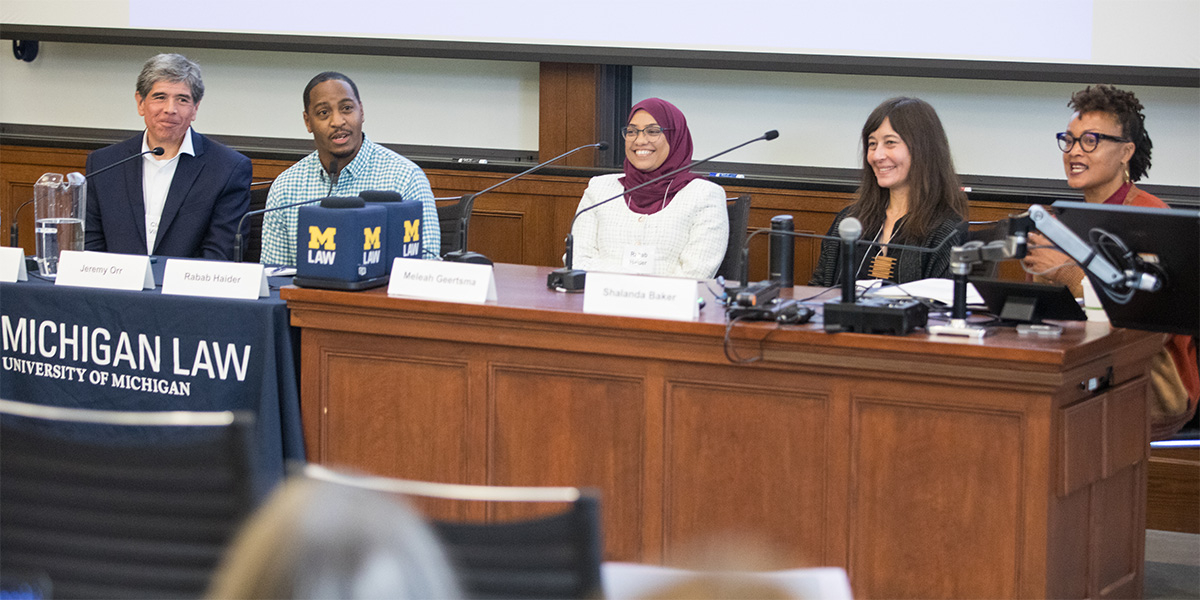
The environmental and energy justice movement continues despite political setbacks.
While the Trump administration has abandoned or reversed past environmental justice efforts, those who work on such issues said at the conference that they still find ways to make progress.
For example, Jeremy Orr, director of litigation and advocacy partnerships at Earthjustice, said the organization has leveraged the political climate as a reason to expand—creating an emerging-issues team and an enforcement team, staffed with former EPA and Department of Justice attorneys. “Our attorneys around the country are representing the hardest hit, most impacted communities in our litigation,” he said.
Cliff Villa, a professor at the University of New Mexico School of Law and former EPA official during the Biden administration, finds hope in the courts. “Across the board, on either end of the political spectrum, we are seeing federal judges standing up for the rule of law right now,” he said. “Think about how you could be defending your right in state courts if you don’t like what’s coming out of federal courts.”
Meleah Geertsma, the director of clean water and equity at the Alliance for the Great Lakes, said the movement must do more to ensure that those who are facing the greatest threats to their well-being are leading and benefiting from environmental advocacy. “If we are only looking to win in the current moment, we are losing a big aspect of what it means to live in a participatory democracy,” she said. “Things like having safe, clean, affordable drinking water, or being free from the threat of flooding or sewage backing up in your house, have been a part of the fight for democracy from the beginning, and I think they need to continue to be part of the fight for our democracy now.”
Tribal nations can play a key role.
Panelist Matthew Fletcher, ’97, the Harry Burns Hutchins Collegiate Professor of Law, said that tribal nations “are on the vanguard of environmental protection and conservation because we have a respect and an understanding of the community, of the entire world.”
Putting that philosophy into practice can mean more powerful protections than the federal government is likely to provide. Riyaz Kanji of the law firm Kanji & Katzen used the fight against Enbridge Energy’s Line 5 pipeline, which goes through the Straits of Mackinac, as an example.
Kanji said the Bad River Band in Wisconsin brought suit in 2019 to evict the pipeline from its reservation, which has been largely successful, using a trespass claim. In addition, the tribe has regulatory authority under the Clean Water Act—so when a company like Enbridge is operating on a reservation, the tribe can require the company to meet the tribe’s water quality standards.
In Michigan, tribes have been fighting the straits crossing using a special status that might not exist for other groups, Kanji said. “Tribes, because of their fishing rights, because of their history with the waters, because of the history of the lands, atmospherically and legally can pack a more significant punch,” he said. “That has been helpful in the Line 5 fight.”
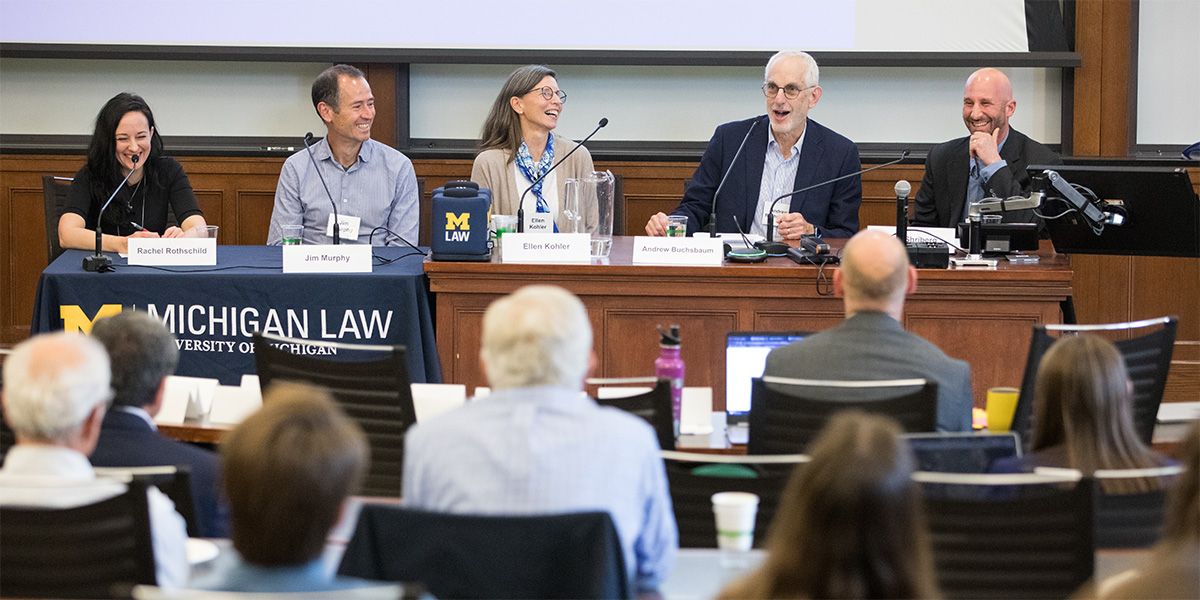
Clean water protections may need to be reinvented.
The Supreme Court and the Trump administration have sharply curtailed the reach of the Clean Water Act—the landmark federal law regulating discharges into the nation’s waterways, widely credited with improving water quality in the US—by limiting where it applies.
Those reductions—coupled with aging infrastructure; new challenges, such as PFAS pollution; and shortcomings in the original law, which does not apply to “non-point” sources like fertilizer runoff—could mean the entire framework should be rethought, panelists said.
Andrew Buchsbaum, a lecturer at the Law School, noted that the Great Lakes hold a special place in the hearts of the public. “The Great Lakes are not an issue. They’re not a program. They’re a value,” he said, and extending that attitude to protect the environment more broadly will be imperative.
Director of Applied Research and Policy Ellen Kohler of the Water Center at the University of Pennsylvania argued for a wholesale reinvention of water protections. “We have a generational challenge in front of us,” she said.
“There are elements of the Clean Water Act that have worked beautifully, but there are elements that have just not worked well, particularly around climate change and environmental justice, for example. We need to take on that challenge now. And that means all of us, everybody in the room.”
The EPA is currently not working, but it can be fixed.
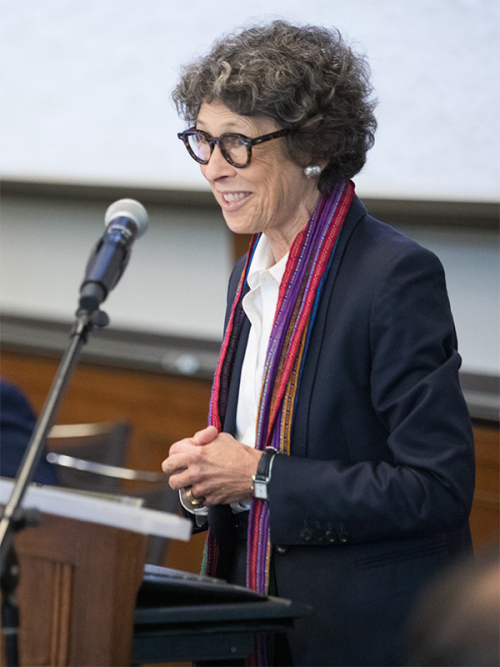
In her keynote, Shore emphasized the importance of enforcing the environmental laws on the books and sharply criticized the current EPA. “What we’re witnessing now is unprecedented. We are seeing a federal agency, the EPA, repudiate its core mission,” she said. “Enforcement has plummeted.”
Nevertheless, she suggested several ways to start rebuilding the agency, including stronger civil service protections for employees, eliminating barriers to rehiring former employees, and getting Congress to prevent the administration from canceling approved grants and other funding.
Shore also called for updating and strengthening foundational laws like the Clean Air Act, Clean Water Act, the Safe Drinking Water Act, and the National Environmental Policy Act. She noted that a recent survey found strong support for those protections across political affiliation, race, and class lines.
“We do need to find ways to streamline permitting, to reduce reporting burdens on grants, to cast a critical eye on the way government agencies deliver for and to the American people,” she said. “Like the gut rehab of a home, we must figure out the essentials to keep and bring the rest up to date. We can fix broken things. We can heal and act.”