
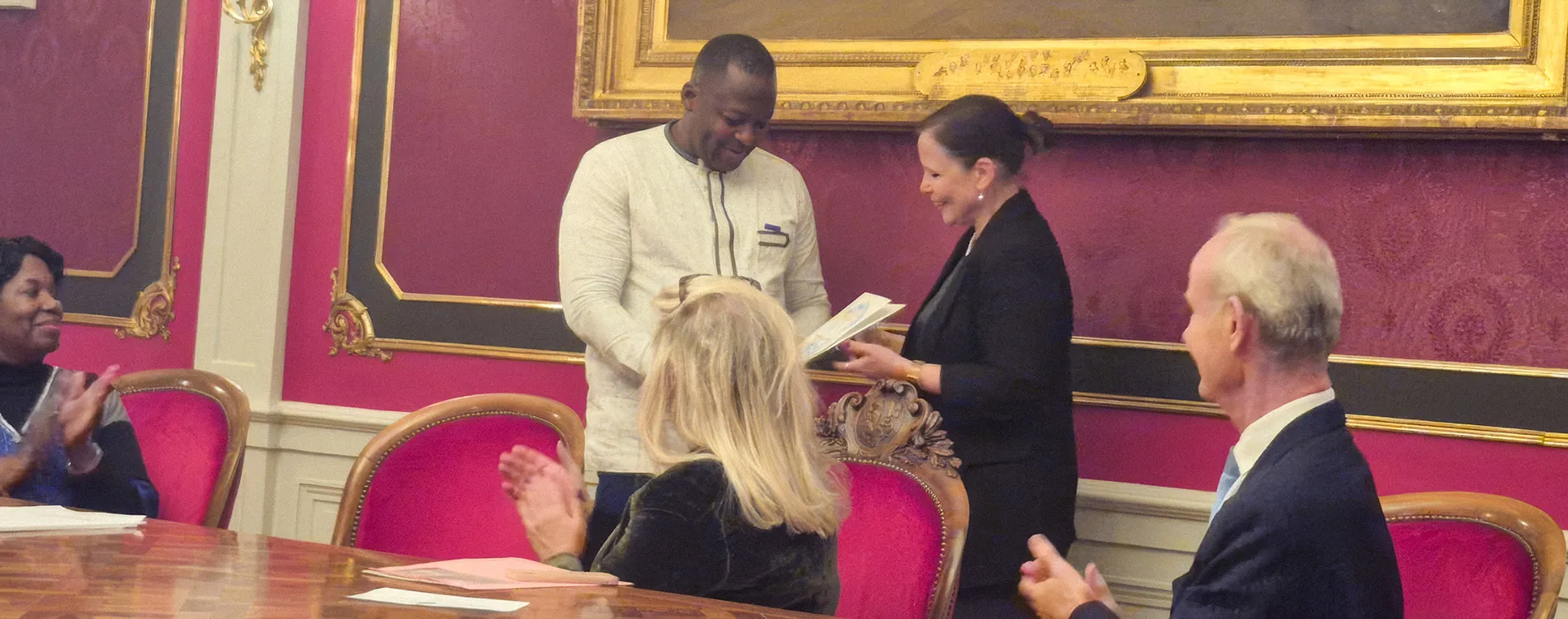
Zakaria Daboné, a practitioner of international humanitarian law and a lecturer and researcher at N. Boni University of Bobo-Dioulasso, Burkina Faso, received the Henry Dunant Field Prize. The prize recognizes “those who embody a spiritual commitment in fighting for human dignity with their research, their ideas, and their gift for communication.”
Daboné was as a research scholar at Michigan Law School in 2011–2012, after defending his doctoral thesis, Le Droit International Public Relatif aux Groupes Armés Non Étatiques (International Law Relating to Non-State Armed Groups), at the University of Geneva in January 2011. It was published in August 2012.
“My time at the University of Michigan strengthened my independent critical thinking and my Anglo-Saxon legal thinking. There, I developed a multidimensional perspective on legal issues in general, and on international law in particular,” he said.
At Michigan Law, Daboné “dived into English-language and other non-continental approaches to international law in order to deepen his scholarly reservoir,” said Steven Ratner, Bruno Simma Collegiate Professor of Law. “In the years since, he has been a leading force promoting the teaching and implementation of IHL [international humanitarian law] and human rights law in Burkina Faso.”
After his time in Ann Arbor, Daboné returned to his home country of Burkina Faso in 2012.
“He has trained soldiers, lawyers, and governmental officials about IHL and served with important national and African Union institutions, in addition to his teaching and research,” Ratner said. “I’m delighted that his important work in Burkina Faso has received such an important recognition internationally.”
Named for the Swiss humanitarian and businessman who co-founded the International Committee of the Red Cross, the Henry Dunant Field Prize is one of the highest honors offered to scholars and practitioners of international humanitarian law, Ratner noted.
Daboné has trained people on the principles of IHL in Burkina Faso and elsewhere. “One of the most emblematic cases involved training actors in armed conflict, both government forces and armed groups, on reconciling compliance with international humanitarian law, international criminal law, and the conclusion of a peace agreement,” he said.
Daboné has also served as permanent secretary of the National Commission on International Humanitarian Law and Human Rights. The commission oversees the implementation of national policy on human rights and international humanitarian law. One of his key accomplishments was initiating the identification, cataloging, and marking of cultural property across the country for protection during armed conflict, he said.
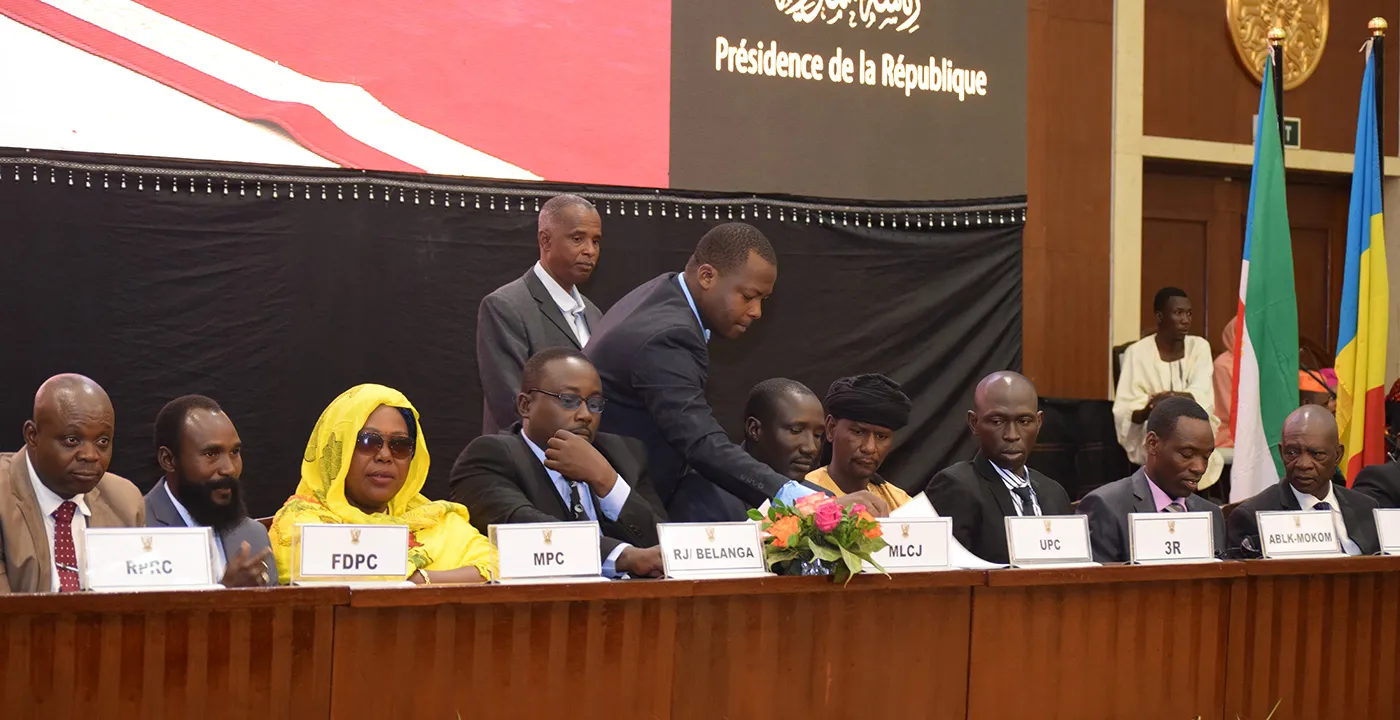
He participated in negotiations that led to the Agreement for Peace and Reconciliation in the Central African Republic in 2019. “Based on government of the Central African Republic proposals and the positions of the 14 armed groups from this country, I had the honor of drafting the first version of the agreement; serving as one of the main organizers of the Khartoum negotiations; advising the lead negotiator, Ambassador Smaïl Chergui (African Union Commissioner for Peace and Security), on certain aspects and adapting and finalizing the agreement according to the negotiation outcomes,” he said.
“This agreement remains the primary framework underpinning the peace maintained in the Central African Republic since 2019, even though subsequent, more limited agreements have since been signed to address specific issues,” he said.
In 2025, on Burkina Faso’s 65th anniversary of national independence, the Burkinabe State elevated Daboné to the rank of Knight of the Order of Academic Palms.
Daboné’s current research focuses on why actors in armed conflicts must apply the law of armed conflict and how this can be achieved. One strand of this research involves “the asymmetric application of IHL in non-international armed conflicts (NIACs). This strand examines government armed forces and their relationship to IHL, aiming to develop a theory of how these forces can apply IHL despite realities such as the internal nature of the conflict and the overall asymmetry of the situation,” he explained.
“Ultimately, my ambition is to challenge conventional wisdom by separating the notions of parties to the conflict and belligerents,” he said. “The goal is to demonstrate that to achieve better IHL compliance in NIACs, we must consider the parties to the conflict separately, since each has its own distinct reasons for respecting IHL.”
In situations of violence and disorder, IHL often is violated. However, “the situational weaknesses of IHL arise because the mechanisms intended to enforce it are inactive. This is partly due to the involvement in warfare of states that wield significant influence in international affairs,” Daboné said.
As someone who straddles both academic research and on-the-ground policy, Daboné emphasizes “the importance of understanding local contexts, perspectives, sensitivities, and fears when applying international law.”
Banner image: Zakaria Daboné received the 2025 Henry Dunant Field Prize in Geneva.