
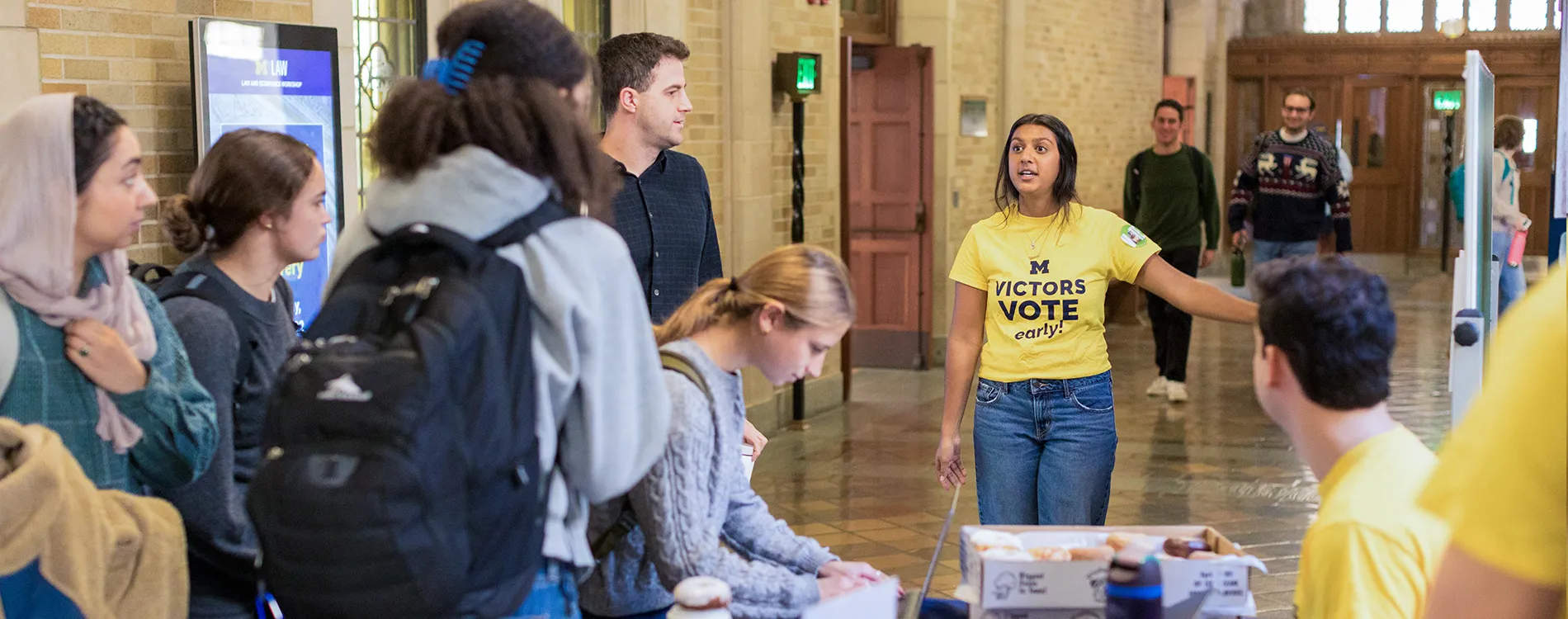
On the first day of 1L orientation, Michigan Voting Project registered 100 law students to vote. Since then, they’ve continued registering voters and helping law students and U-M undergrads register and vote.
On Election Day, dozens of Michigan Law students fanned out in and around Ann Arbor to serve as poll workers and volunteers.
Michigan Voting Project (MVP) is a nonpartisan, student-led, and faculty-sponsored group that gives Michigan Law students opportunities to explore legal issues in elections, campaigning, and voting rights.
Election Day
With Law School classes canceled on Election Day, students were freed up to help others vote. Around 60 Michigan Law students participated in nonpartisan election activities through MVP, while others spent Election Day doing political work.
About 25 law students worked for the Ann Arbor City Clerk as poll workers, as temporary clerks to register voters, and to staff election receiving boards after the polls closed. Others worked as election monitors and challengers, volunteered at a campus voting hub, and staffed the election protection hotline 866-OUR-VOTE.
MVP partnered with Promote the Vote Fund, which sent students to various polling stations to serve as monitors and challengers, and trained students to work the hotline, which is intended for people who have questions about their ballots and for reporting things happening on the ground at polling stations, said 2L Alexander Shehab, co-president of MVP.
“The beautiful thing about having law students in those roles is that they’re good at following rules and following procedures,” he said. Also helpful is knowing “that legal chain of command that we learn through experience at our summer jobs and such, and passing more complicated matters up the chain.”
2L Bianca Shah, MVP co-president, agreed. “Law students are good at remembering information, reciting it, and applying it to the person’s situation that is coming to them with questions.”
Getting involved is natural for law students. “I think it would be hard to be in law school and not recognize the underpinning of every class—everything we learn—is the importance of elections,” Shehab said. “We talk so much about the democratic process in class. To actually get our hands on it is exciting.”
Professor Roseanna Sommers, MVP’s faculty adviser, said, “As budding lawyers, our students are really well-positioned to help make sure our elections run smoothly and fairly and that all the proper procedures are followed.”
Before and after the election
This fall, MVP registered more than 200 Michigan Law students to vote, and the group gave even more students information on how to register online themselves, Shehab said.
Throughout the semester, MVP manned tables in Hutchins Hall to register voters and answer questions. During early voting, many Michigan Law students stopped by the tables to confirm what they needed to have in place before voting, left to vote, and came back to thank the volunteers, Shah said.
Members of MVP also registered undergrads through UMICH Votes, a nonpartisan University-wide coalition. They staffed campus voting hubs at the University of Michigan Museum of Art (UMMA) and on North Campus, helping students register, use absentee ballots, vote early, and generally figure out what they needed to do to vote. The voting hubs served as satellite Ann Arbor City Clerk’s offices and were open for early voting from October 21 to November 2 and open for same-day registration and voting on Election Day.
In the lead-up to the election, MVP students visited classes across the University, from entry-level courses to PhD programs, to talk about voting. In speaking to undergrads, “We have a semblance of authority because we’re law students. When we go into a room and we’re talking to them, they are a little bit more willing to listen than if it was just another undergrad or a peer of theirs,” Shah said.
Law students’ communication skills come in handy in speaking to undergrads and in other situations, said 2L Sela Adegbile, MVP’s VP of communications. “Throughout all the volunteer opportunities, clear communication is critical, making sure people know exactly what they have to do and when they have to do it.”
“MVP has obviously been a vital resource for law students, but they’ve been so helpful in educating undergraduates about the process of voting,” including being invited to classrooms through UMICH Votes, said John Barry Ryan, faculty director of UMICH Votes and associate professor in the Department of Communication and Media and Department of Political Science. “MVP is an essential part of the UMICH Votes coalition.”
Even though law students tend to be civically engaged, many of them didn’t know all the specifics of exactly how, when, and where they could register or vote, Shah said. For example, some students from other states thought that if they voted in Michigan, they would need to change their permanent residency, but students can vote as temporary residents of Michigan, she said.
In the week or so before the election, some were surprised to hear that it wasn’t too late for them to vote in Ann Arbor rather than by absentee ballot, Shehab said.
“Walks to the polls” were another MVP initiative: During early voting, several affinity groups and 1L sections walked to UMMA to vote together.
In the spring and in non-election years, MVP organizes events for speakers to come in and talk to students about election law and voting rights work.
“I believe in democracy, and I think our role as young people who are quick learners and law students is really important to make sure that things run smoothly,” Adegbile said. “It’s really exciting to be a part of election protection work—and in a state like Michigan, where your vote has a lot of power.”