
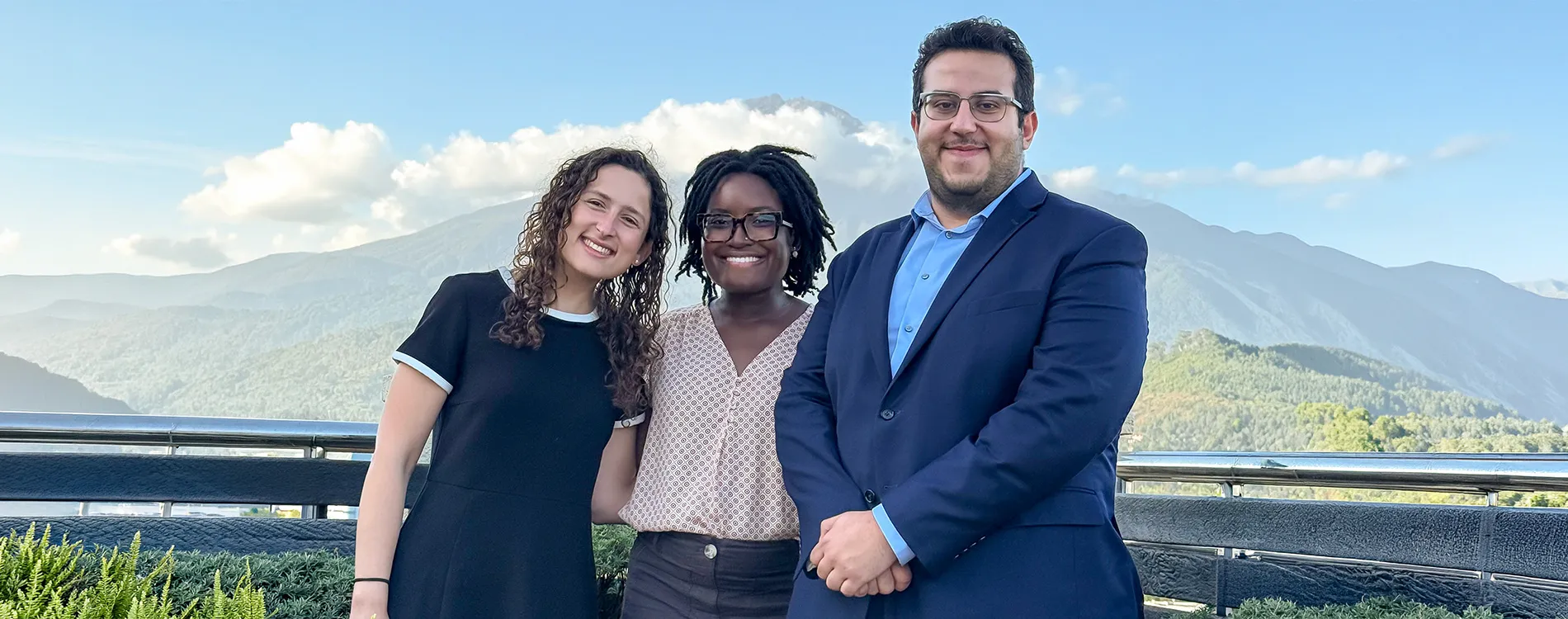
Over the summer, two recent Michigan Law graduates and one third-year law student participated in a two-week academic program in Arusha, Tanzania, on African law and African Union law. They were the only American students invited to participate.
Through the Law School’s Center for International and Comparative Law (CICL) and the Clara Belfield and Henry Bates Overseas Fellowship, Lindsey Bressler, ’26; Moamen Keshlaf, ’26; and Awo Onwudiwe, a 3L, traveled across the globe in early August for the 2026 Kilimanjaro Academy on African Union Law and the Public Law of Africa.
Facilitated by the African Institute of International Law (AIIL), the Kilimanjaro Academy is designed to give participants a deeper understanding of Africa’s legal frameworks by covering key areas such as peace and security, human rights, environmental law, and the African Continental Free Trade Area through lectures delivered by leading African scholars, judges, and practitioners. The program, which is by invitation only, is open to students, professionals, government officials, and policymakers interested in African legal systems.
The Hon. Abdulqawi Ahmed Yusuf, a former president of the International Court of Justice (ICJ), founded AIIL in 2012 and serves as its president. The Law School’s invitation to participate in the Kilimanjaro Academy came from the school’s ongoing connection with Judge Yusuf, particularly after he visited campus to give the 2025 Bishop Lecture.
“The overwhelmingly positive response to this year’s program really shows why we value our new partnership with AIIL, but it also reflects so well on these three remarkable students,” said Eric Christiansen, assistant dean of international affairs.
“It’s been exciting to hear their expansive, even adventurous, attitude toward this intensive learning experience. It’s a global perspective that Michigan Law has always valued—and it will serve them well in their professional lives.”
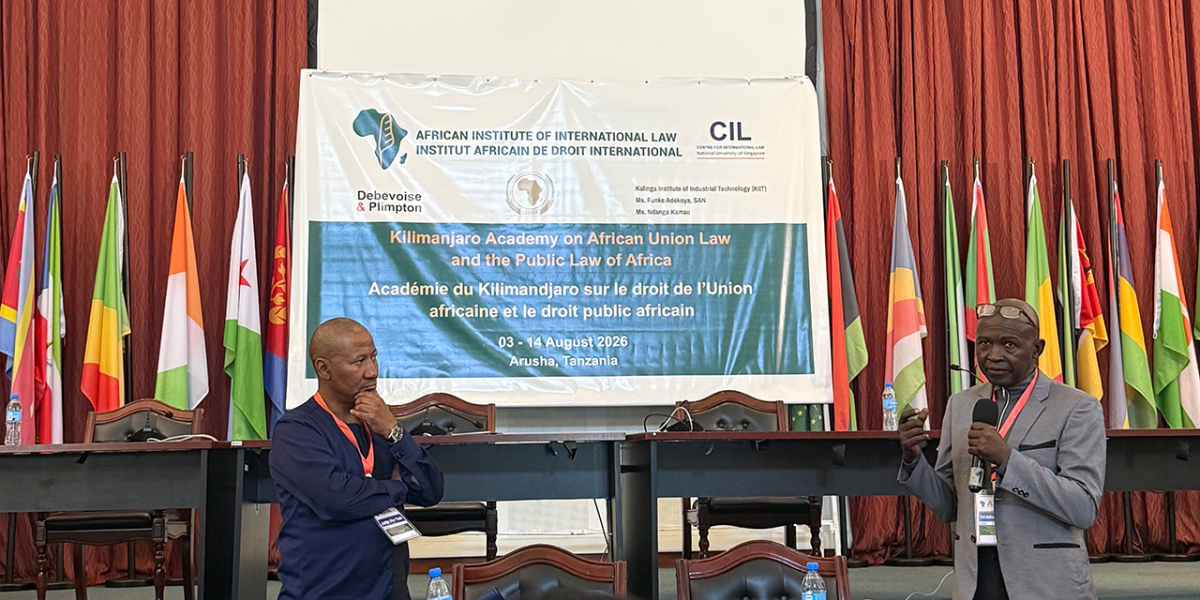
Meet Michigan Law’s 2026 Kilimanjaro Academy Participants
Lindsey Bressler, ’26

After serving as a Peace Corps volunteer in Tanzania from 2018 to 2019, Bressler was thrilled to receive an email from CICL about the Kilimanjaro Academy.
“This program is one of the coolest things I’ve gotten to do in law school,” she said. “It was one of those once-in-a-lifetime opportunities to hear perspectives that you don’t get exposed to in doctrinal classes. Plus, during the two weeks, I was laughing every day, meeting new people, and experiencing a lot of warmth from the other participants.”
Bressler said that being one of three American participants, alongside Keshlaf and Onwudiwe, was eye-opening. They spent time at the African Court of Human Rights, learning about agreements on African free trade, environmentalism and climate change, legal frameworks in the African continent, and Pan-Africanism.
“There were professors from across the African continent: Burundi, Tunisia, Morocco, and Lesotho,” she said. “We also had the opportunity to visit the International Criminal Tribunal for Rwanda (ICTR) and the African Union Advisory Board Against Corruption.”
Bressler said her experience taking Professor Nico Howson’s course on Chinese constitutionalism during her 1L year shaped her approach to the Kilimanjaro Academy. Howson set a precedent: he would not teach a comparative law class. Instead, students would learn about the Chinese legal system within its own framework, rather than comparing it to European or American constitutional frameworks.
“I had never approached international affairs in the field that way; I’ve inherently been comparing everything to the American framework,” said Bressler. “Getting to take that class, adopting that mindset, and applying it to African legal systems was really helpful for me.”
In October, Bressler will join Gibson Dunn in New York. After graduating and taking the bar exam, she said she enjoyed “having the opportunity to be a learner again” through the Kilimanjaro Academy.
Moamen Keshlaf, ’26
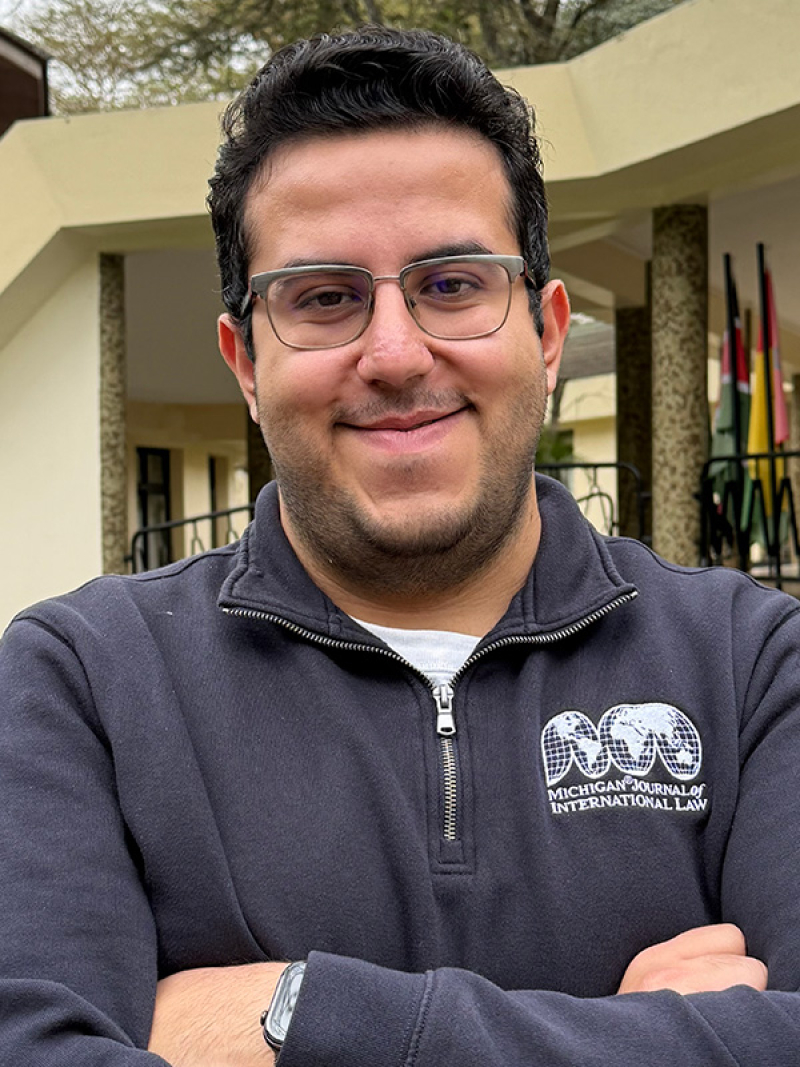
Keshlaf matriculated at Michigan Law with a focus on international law. During his 1L summer in 2024, he worked at the UN International Law Commission in Geneva through the International Summer Public Interest Internship program. Then, in 2025, Keshlaf, who is Libyan, was inspired by ICJ Judge Abdulqawi Yusuf’s Bishop Lecture at Michigan Law. He also served as the editor-in-chief of the Michigan Journal of International Law during his 3L year.
When Keshlaf learned about the Kilimanjaro Academy and that Judge Yusuf was behind it, he saw it as the perfect opportunity to build on his interest in international and comparative law.
“Many of the participants were from Tanzania, and I happened to know some of them from Geneva,” said Keshlaf. “It was great to catch up with them. I also was able to meet, network with, and listen to a number of people who I recognized from their work, like Judge Dire Tladi on the ICJ—whose work is widely cited in the scholarship we published and reviewed during my time as editor-in-chief of the Michigan Journal of International Law—and Professor Obiora Okafor, who came to Michigan Law through the International Law Workshop.”
He continued, “The Kilimanjaro Academy is a way to get out of your comfort zone, out of the American legal system, network, and further your understanding of how other countries do things and think about shared issues. I really hope that Michigan Law continues investing in this program and continues its connection with the AIIL. Organizations like the AIIL do not have the same resources or visibility as their Western equivalents, which makes it all the more important that we support them, spread the word about their work, and encourage others to participate as we continue to elevate African voices on the international legal stage. The more people attend, the more we can contribute to the program while also making the discussions richer and more diverse.”
Keshlaf has joined Sullivan & Cromwell LLP in New York in the firm’s corporate group, with an interest in working in international law down the line.
Awo Onwudiwe, 3L

As a 2L, Onwudiwe participated in the semester-long Geneva Externship program at Michigan Law. Her experience with International Bridges to Justice (IBJ), which provides training on the Global South for public defenders, inspired her to sign up for the Kilimanjaro Academy.
“IBJ did a lot of work in Africa, and working with them was the first time I was exposed to African law and African Union law,” she said. “Then, I saw an email from CICL about the Kilimanjaro Academy, and thought it would be the perfect opportunity to expand my knowledge.”
Onwudiwe said each day of the program was jam-packed with informative sessions delivered by inspiring professors, lawyers, or judges.
“I will remember the people there more than anything,” she said. “There were a lot of Tanzanian law students there, and it was really cool getting to see what people were studying, learn about the Tanzanian law school system, and understand what their legal goals were. Lindsey, Moamen, and I were the only Americans there, and we became quite close by the end of the two weeks.”
As a third-year public interest student, Onwudiwe is focused on applying to jobs. She also serves on the e-board for the International Law Society, through which she hopes to create events focused on African Union law at the Law School.
To anyone interested in participating in the Kilimanjaro Academy, Onwudiwe said, “I highly recommend going; it’s like a full semester’s worth of education in two weeks. You get to meet so many awesome professors, professionals, and students from around the world. Especially if you have any connection to Africa, you should do it. But even if you don’t, why wouldn’t you want to go to Tanzania for two weeks?”