
Two Michigan Law postgraduates, Augusto Colín, LLM ’26, and Ross Franke, LLM ’26, have been selected for the 2026 Virginia Gordan LLM Public Service Fellowship. The fellowship will support their work at the Inter-American Court of Human Rights, the United Nations International Law Commission, the UN High Commissioner for Refugees, and the Constitutional Court of South Africa.
Launched in spring 2025, the fellowship is named for the Law School’s first assistant dean for international affairs and supports postgraduate transnational public service and public interest work at NGOs, foreign or international courts, and other globally significant public service organizations.
Viktoria Baumgartl, LLM ’25, and Dmytro Soldatenko, LLM ’25, were the inaugural recipients.
“Our LLM students make a remarkable commitment coming to Michigan, often leaving behind their families, established careers, professional networks, and communities. We want to honor that commitment by supporting them not only while they’re here, but as they take their next steps,” said Elizabeth Snook, international affairs program manager and Center for International and Comparative Law staff member. “Our graduates remain part of the Michigan Law community well after they receive their degrees, and we’re especially fortunate that Ross and Augusto are now part of that community.”
Read more about the work of this year’s fellows below.
Augusto Colín, LLM ’26
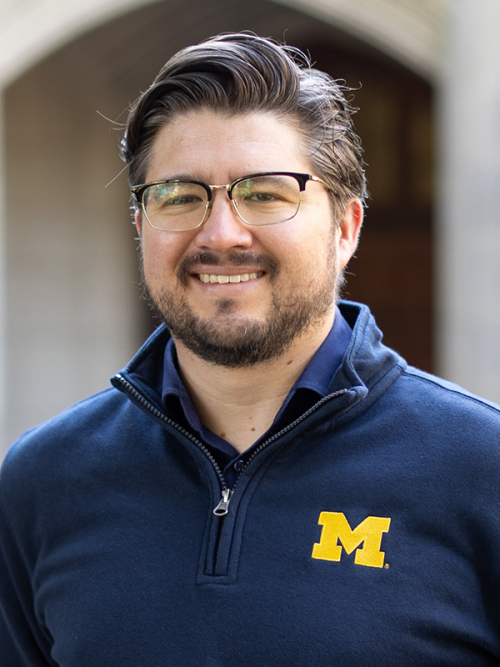
From September to December 2026, Colín is working at the Inter-American Court of Human Rights (IACtHR) in San José, Costa Rica, as a visiting professional. The IACtHR is the judicial body of the Organization of American States, which oversees compliance with the American Convention on Human Rights. In 2013, while Colín was earning his law degree in Mexico at the Facultad Libre de Derecho de Monterrey, he completed a six-month internship at the IACtHR, where he assisted on a case involving the criminalization of protests by Mapuche communities in Chile directed to recover their ancestral lands.
That experience inspired Colín to pursue a judicial career, leading him to clerk for more than 10 years in Mexico, at the Electoral Tribunal of the Federal Judiciary and at the Supreme Court of Justice. His work frequently involved applying constitutional and international standards to disputes with significant social, political, and institutional impact.
Following his LLM program at Michigan Law, where he specialized in environmental law and climate justice, Colín completed a summer fellowship at Yale Law School’s Environmental Justice Litigation and Advocacy Clinic, where he deepened his understanding of public interest law in the US.
Colín said that returning to the IACtHR after more than a decade is meaningful. This time around, his responsibilities will include assisting the court’s legal staff with research on applicable standards for human rights issues; analyzing and proposing solutions for provisional measures and the merits of contentious cases; monitoring compliance with judgments; and providing logistical support during public hearings.
“I see this as a unique opportunity to give back to the institution and contribute to the development of case law in emerging topics, such as climate justice.”
Ann Arbor may be in Colín’s future as well. “My goal after the Virginia Gordan Fellowship is to return to Michigan Law,” he said. “I would love to apply for the SJD program, continue to specialize in environmental and climate justice, and develop research in those areas. I think Michigan Law would be the perfect place to continue developing my academic career so I can return to Mexico and teach.
“Also, only one year at Michigan Law felt too short for me to take full advantage of the amazing faculty and learning opportunities.”
Ross Franke, LLM ’26

Franke’s fellowship spans Switzerland, Rwanda, and South Africa. “My goal is to work in international law and human rights,” he said. “These placements build toward that from three directions: how international law is made, how refugees are protected, and how international norms are given domestic effect.”
This summer, Franke used his fellowship to work in Geneva, Switzerland, as a legal assistant to Professor Dapo Akande, a member of the United Nations International Law Commission (ILC), during its 77th session. The ILC prepares draft articles and conclusions, accompanied by commentaries. Franke was one of six who reviewed chapters of the ILC’s draft annual report before its 34 members adopted it. He personally reviewed three chapters: due diligence in international law, immunity of state officials from foreign criminal jurisdiction, and general principles of law.
“International courts and tribunals have relied on the commission’s texts, including the commentaries explaining them, to determine the law. So, a seemingly minor change in language can have major consequences,” he said. “Reviewing the chapters, I asked myself: Did the commentary state the rule more narrowly than the draft article or conclusion it explained? Did its wording go further than the Commission intended? Did its sources say what they were cited for?
“Professor Akande had to decide which points were worth raising. My job was to make that decision easier, so I sent him only what was material, usually with a suggested amendment drafted in full.”
The placement stood out for its range. “You’re not confined to one corner of the discipline,” he said, “and you come away with a much better sense of how the whole of it holds together.”
A few weeks later, Franke arrived in Kigali, Rwanda, to work for the United Nations High Commissioner for Refugees (UNHCR) as a resettlement fellow. The Virginia Gordan LLM Public Service Fellowship also funds this work.
“Through interpreters, I interview asylum-seekers to understand why they fled and what they fear if they return home,” he said. “I assess whether their fear of persecution is well founded and recommend whether UNHCR should recognize them as refugees. They include survivors of sexual violence and of attacks on civilians during armed conflict.”
From January to June 2027, Franke will serve as a foreign law clerk at the Constitutional Court of South Africa, spending three months each in the chambers of Justice Leona Theron and Justice Kate Savage. He will help each justice draft and edit judgments, researching South African law and comparing how courts in other jurisdictions have approached similar questions.
“The South African constitution weaves international law into domestic adjudication,” he said. “It requires courts to consider international law when interpreting the Bill of Rights, and to prefer any reasonable interpretation of legislation that is consistent with international law. Customary international law is law in South Africa. Few constitutions go this far.
“As a human rights litigator in Aotearoa New Zealand, I did that work from the advocate’s side. Now I’ll see that process from the other side of the bench.”