
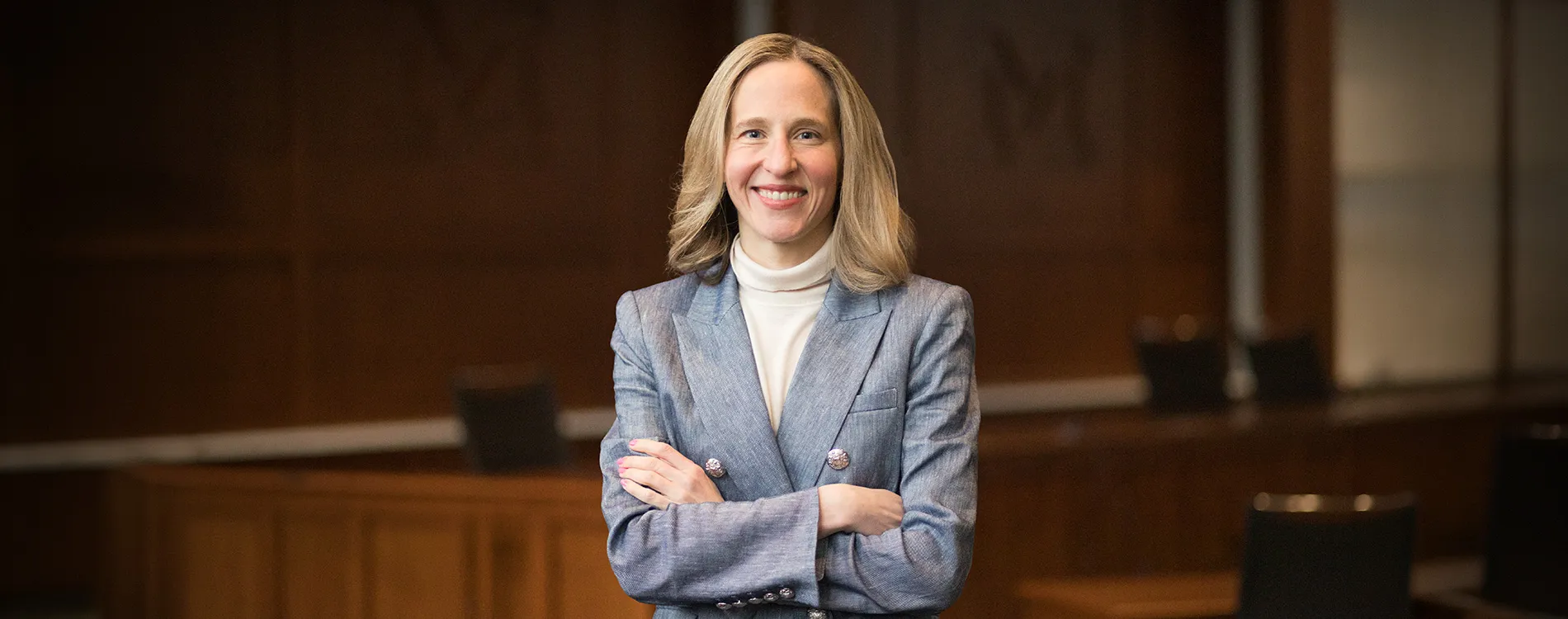
The American Constitution Society (ACS) has named Professor Leah Litman, ’10, as the winner of its 2026 Richard D. Cudahy Writing Competition on Regulatory and Administrative Law.
Litman, who is also associate dean for faculty and research, and her co-authors were honored for their paper “Unsettling the Presidency,” which explores the president and the administration’s actions that leverage or appropriate the powers of the US court system. In particular, they argue that the administration has gone beyond simple attacks on the courts and is attempting to usurp their authority—in “an all-out assault on the separation of powers.”
“We have been thinking about this for the better part of two years at this point,” Litman said. “We thought we were onto this new idea because we saw so many different novel exercises of presidential power, and we wanted to try to find a way to explain how they were connected and what the unifying themes were.”
This is Litman’s second time being honored in the Cudahy competition. She also won in 2023 for a paper co-authored with Professor Daniel Deacon. Nicholas Bagley, the Thomas G. Long Professor of Law, won the competition in 2015.
“Michigan Law is really becoming a powerhouse in administrative law,” Litman said. “We have faculty who approach administrative law issues from many different angles—some from a more historical lens, some from more doctrinal, some from more descriptive.”
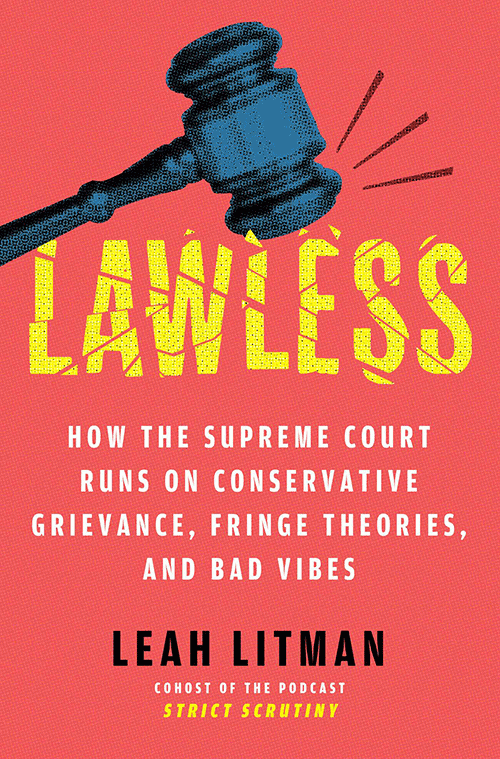
Litman teaches and writes on constitutional law, federal courts, and federal post-conviction. She is the author of the recent New York Times best-selling book LAWLESS: How the Supreme Court Runs on Conservative Grievance, Fringe Theories, and Bad Vibes (2025).
In 2023, the American Law Institute named Litman a recipient of its Early Career Scholars Medal. Also in 2023, the ACS recognized Litman with the Ruth Bader Ginsburg Scholar Award.
“Both times my work was recognized in the Cudahy competition, it was for co-authored pieces,” Litman said. “That is a testament to the value of collaboration and getting more people’s eyes and minds around an idea and how that makes it better, which is very much part of the academic enterprise.”
The competition honors Judge Cudahy’s legacy in regulatory and administrative law. “His significant contributions reflected his keen understanding of legal doctrine, deep insight into the institutional forces that determine how doctrine is implemented, and appreciation of the public impact of doctrinal and institutional choices, including the consequences for fundamental values such as fairness, participation, and transparency,” according to the ACS announcement. “The award aims to encourage and reward these qualities in the scholarship of others.”
The ACS is an organization that interprets the Constitution based on its text and against the backdrop of history and lived experience. Through a diverse nationwide network of lawyers, law students, judges, scholars, and many others, the ACS strives to uphold the Constitution by ensuring that law is a force for protecting democracy and the public interest and for improving people’s lives.