

A recent Michigan Law JD graduate and LLM graduate have received the Kouba Prize, which is awarded each year for outstanding student papers on European Union (EU) law and international peace and security.
Cody Mills, ’26, was selected for his paper on EU law, and Lukas Blum, LLM ’26, was chosen for his paper on international peace and security.
Both papers tackle the concept of neutrality, but in different contexts: bans on religious headscarves and intellectual property (IP) at a technical agency that is part of the United Nations.
The Kouba Prize awards are available through the generosity of Jon Henry Kouba, ’65.
European Union law
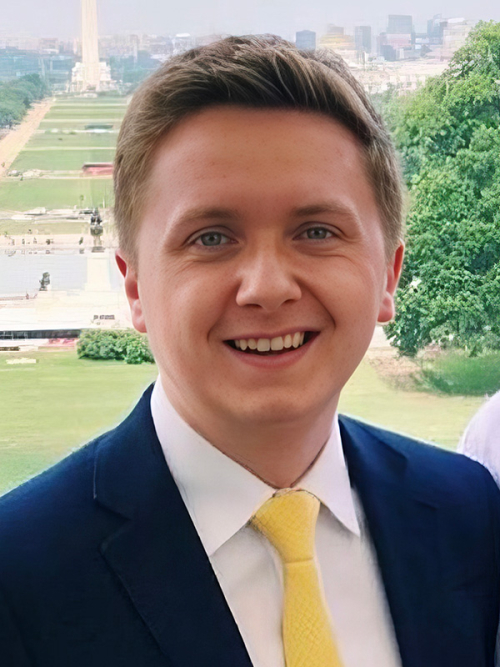
Mills’s paper, “Some Women Are Created Neutral: The Limits of Equality for Muslim Women at the European Court of Justice,” discusses the regulation of headscarves that some Muslim women wear.
Mills argues that the Court of Justice of the European Union (CJEU) has created a doctrine of neutrality that allows employers and public bodies to restrict visible religious expression—but that purportedly neutral dress codes “disproportionately exclude visibly Muslim women from employment, educational pathways, and public-sector opportunities.”
Bans on headscarves “target a practice intimately connected to religious exercise and lived identity,” he wrote. Mills’s interest in this topic stemmed from realizing that both secular governments and more religious governments have allowed their states to ban Muslim headcoverings.
In his European Union Law class with Daniel Halberstam, Eric Stein Collegiate Professor of Law and director of the European Legal Studies Program, Mills read a number of CJEU decisions. He found “a trajectory of a lot of what we would consider in the US really progressive opinions when it comes to LGBTQ rights, children’s rights, things of that nature,” he said. But when the class got to decisions on religious headcoverings, “I noticed it diverged into a much more fundamentalist, right-wing, restrictive perspective.”
Because the CJEU isn’t known for this restrictive perspective, Mills said, he wondered why it was the case for headscarves. In other arenas, “the court has demonstrated its capacity to weigh real-world effects, interrogate the necessity of restrictive measures, and safeguard individual rights against both state and private interference,” but not with headscarves, he wrote.
After reading more decisions, Mills concluded that the only way for the CJEU to keep headscarf cases aligned with its other decisions on issues of autonomy, freedom from harassment and discrimination, and other fundamental rights is “to fully mandate that headscarves be allowed in popular society,” including workplaces, schools, and other public institutions.
Mills said Halberstam’s teaching helped him appreciate these issues. “He does such an amazing job of connecting each EU law case to prior cases that we would’ve read in constitutional law in a way that helps us to conceptualize what we already know and place it in an EU context so it doesn’t feel as hard to digest.”
Religious headcoverings are “a topic that I think is becoming more and more important with time, as we see continued cultural clashes at universities and continued mistreatment of Arab individuals,” Mills said. “I think it’s invaluable to have these conversations going, and to have an award for it means a lot.”
International peace and security

Blum received the Kouba Prize for international peace and security for his paper “Neutrality at WIPO.” He wrote it as part of Professor Kristina Daugirdas’s United Nations seminar.
Anna Morawiec Mansfield, legal counsel of the World Intellectual Property Organization (WIPO), visited the seminar and spoke about her work, and the issues she raised sparked Blum’s interest.
His paper looks at what neutrality means in the context of different institutions. Traditionally, neutrality refers to a state abstaining from armed conflict and remaining impartial toward the belligerents. This concept cannot simply be applied to an international organization like WIPO, which faces more complex legal and institutional questions, he said.
WIPO promotes intellectual property worldwide and administers international IP treaties. A central distinction in Blum’s paper is between WIPO’s International Bureau, which handles treaty administration, and its intergovernmental bodies, where member states make decisions. Unlike the latter, the International Bureau can invoke professional neutrality in carrying out WIPO’s mandate.
Blum argues that such neutrality depends on the context of the institution, and he uses three case studies. “In each case, I ask who invokes neutrality, in relation to whom, and what institutional function that neutrality claim performs,” he said.
The cases examine a North Korean international patent application for a sodium cyanide production process, with the substance listed by the UN sanctions committee as a chemical-weapons precursor; Afghanistan’s representation at WIPO following the Taliban takeover; and WIPO’s development of an assistance track for Ukraine’s intellectual property system after Russia’s invasion.
These cases reveal different forms of neutrality. In the North Korea case, neutrality takes the form of technical rule application within WIPO’s treaty mandate; in the Afghanistan case, it involves institutional deference; and in the Ukraine case, it takes the form of technical assistance framed through WIPO’s mandate, Blum explained.
“Neutrality at WIPO does not mean standing outside political life. It means handling political pressure through forms that fit the organization’s technical mandate,” he wrote.
About the prize, Blum said, “I feel incredibly honored. Attending Michigan Law was one of the best things I ever did. I learned so much from my peers. And I am very grateful to Professor Daugirdas for her guidance and for inviting Anna Morawiec Mansfield; otherwise, I would never have thought of this topic.”
Blum studied law in Germany and returned there after earning his LLM. He is completing Germany’s two-year legal traineeship, which concludes with the second state examination.
When Blum first decided to pursue an LLM, he was more interested in corporate law, but his interest in international law has grown—particularly EU law, thanks to his EU class with Halberstam, which he took alongside Mills, he pointed out.
“The Kouba Prize recognizes students who produce outstanding papers grappling with difficult, often cutting-edge, questions of law and legal policy,” Halberstam said. “Our congratulations to Cody and Lukas on their excellent work.”