

The US Supreme Court recently decided Landor v. Louisiana Department of Corrections and Public Safety et al. 6-3, finding that a Louisiana man can’t sue corrections officers for damages for violating his religious rights under the Religious Land Use and Institutionalized Persons Act (RLUIPA).
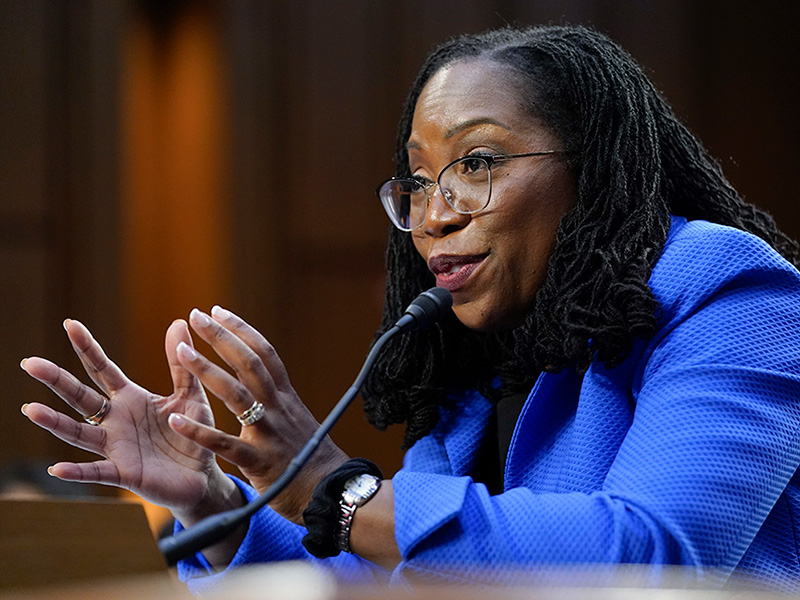
Justice Ketanji Brown Jackson filed a dissenting opinion to the ruling that Justices Sonia Sotomayor and Elena Kagan joined. In arguing that the majority misconstrued the Constitution’s spending clause and necessary and proper clause, Jackson cited a paper that Professor Samuel Bagenstos wrote, “Spending Clause Litigation in the Roberts Court,” which was published in the Duke Law Journal in 2008.
Jackson wrote that “the Court takes a step toward embracing what one scholar has criticized as the ‘strong contract theory’: the radical notion that Spending Clause legislation is not just ‘“in the nature of” a contract,’ but is in fact ‘nothing but a contract,’” referring to Bagenstos’s paper.
Bagenstos, the Frank G. Millard Professor of Law, had argued in that paper that the Supreme Court was likely to limit Congress’s conditional spending authority—but indirectly, by limiting private parties’ ability to enforce funding conditions. In Landor, the court has done just that, Bagenstos said.
At the center of this case is Damon Landor, a practicing Rastafarian whose religious convictions require him to leave his hair uncut. When he was transferred from one corrections facility to another, officers held him down and shaved his head, even after he had informed them of his religious convictions and RLUIPA.
Landor filed suit against the Louisiana Department of Corrections and some of its individual officers, seeking damages. The Supreme Court held that Landor can’t sue the individual officers for damages.
Bagenstos recently answered five questions about this case and its implications:
1. What is at issue in the Landor case?
The precise issue in the case was whether a prisoner whose religious rights were violated could sue the individual prison official who violated their rights or whether their only lawsuit could run against the state itself. The court had already said you can’t sue the state for damages, because the state has sovereign immunity against damages. So the only way that an individual could get effective relief would be to sue the individual prison official who violated their rights. And the court here said you can’t sue them either.
The RLUIPA statute says if a state prison accepts federal funds, then it has an obligation to provide accommodations to the religious exercise of prisoners. And what the court said is: That may be binding on the state, but that’s not binding on the people who work for the state, at least to the extent that they can’t be individually sued for violating it.
But the state only operates through people. In Landor, the court said that the person whose rights are at stake, whose rights are being protected by Congress, has no ability to challenge the individual action of the person who actually violated their rights under the statute.
2. In Landor, has the majority done exactly what you predicted the Supreme Court would do to limit private parties’ ability to enforce funding conditions?
They’ve certainly done that, and I think they’ve gone further. What I tried to do in that paper almost 20 years ago was predict the various directions the court’s jurisprudence on the spending clause might go. I said it would certainly be the case that a conservative Supreme Court under Chief Justice John Roberts would limit the ability of private parties to enforce spending clause laws. Before Landor, they also did it in the Medina case involving Planned Parenthood last year and in a number of other cases. That’s been a pretty consistent theme.
I also said in the paper that there is this more extreme argument that they might endorse in order to achieve that goal of limiting the enforcement of spending clause statutes. This argument is that statutes that Congress adopts under the spending clause aren’t really laws in any traditional sense—that they essentially are proposals to enter into a contract.
The court adopted this idea that a spending clause statute is really just a contract and can’t bind anybody who works for the entity who contracted with the federal government. It can only bind the particular party that contracted with the federal government. The dissent quoted my argument and said this extreme theory really doesn’t make sense as a constitutional matter.
3. What implications does this decision have beyond religious rights?
The crucial thing is that Congress said you can sue an official for damages, and the court said, no, you really can’t. They’re reading the Constitution as limiting what Congress can do in a way that causes very significant harm to Congress’s ability to create remedies.
As Justice Jackson points out in her dissent, there are an incredible number of really significant statutes that Congress adopted under its spending power. That includes a lot of civil rights statutes, like Title VI of the Civil Rights Act, which protects against race discrimination; and Title IX of the Education Amendments, which protects against sex discrimination in education; and the Rehabilitation Act, which protects against disability discrimination. It also includes things like Medicaid, the unemployment insurance system, and the foster care system.
There are lots of programs that people rely on every day that are based on conditional federal spending. By saying that those terms of Congress’s grants can only be constitutionally enforced against the state itself and not against the individuals who actually are tasked with carrying them out, that can substantially limit the ability of Congress to make sure that the important purposes of these spending clause statutes are carried out.
4. How has the legal landscape changed on this issue in the last couple of decades?
The reason I wrote the article about the spending clause in the Roberts court back in 2008 is because it seemed pretty clear that the spending clause was going to be a big focus for a conservative court moving forward.
The court has, on a number of fronts, made it much harder for Congress to attach conditions to federal spending. When they invalidated the Medicaid expansion in Obamacare, they adopted a new constitutional rule making it harder for Congress to attach conditions, but they’ve also—in a very significant way—made it much harder to enforce those conditions.
In Landor, they’re saying there’s also potentially constitutional limitations to who is covered by spending clause legislation and how they’re covered by it. I think there’s been a steady constriction of the ability of individuals who have rights under spending clause statutes to vindicate them—and a steady constriction of Congress’s ability to use the spending clause to vindicate important national priorities.
5. Where do we go from here?
There’s still going to be a lot of litigation about this. There are so many statutes that attach conditions to federal spending, and they really matter to people.
If you think about the applications of the civil rights laws in the university context, or you think about Medicaid—which is the largest item on most state budgets—and all the controversies over what gets covered in Medicaid, how it gets covered, how much is spent, all of that is the subject of litigation all the time. So we’re bound to see future tests of just how broadly the Supreme Court’s new ruling shielding states will extend.