
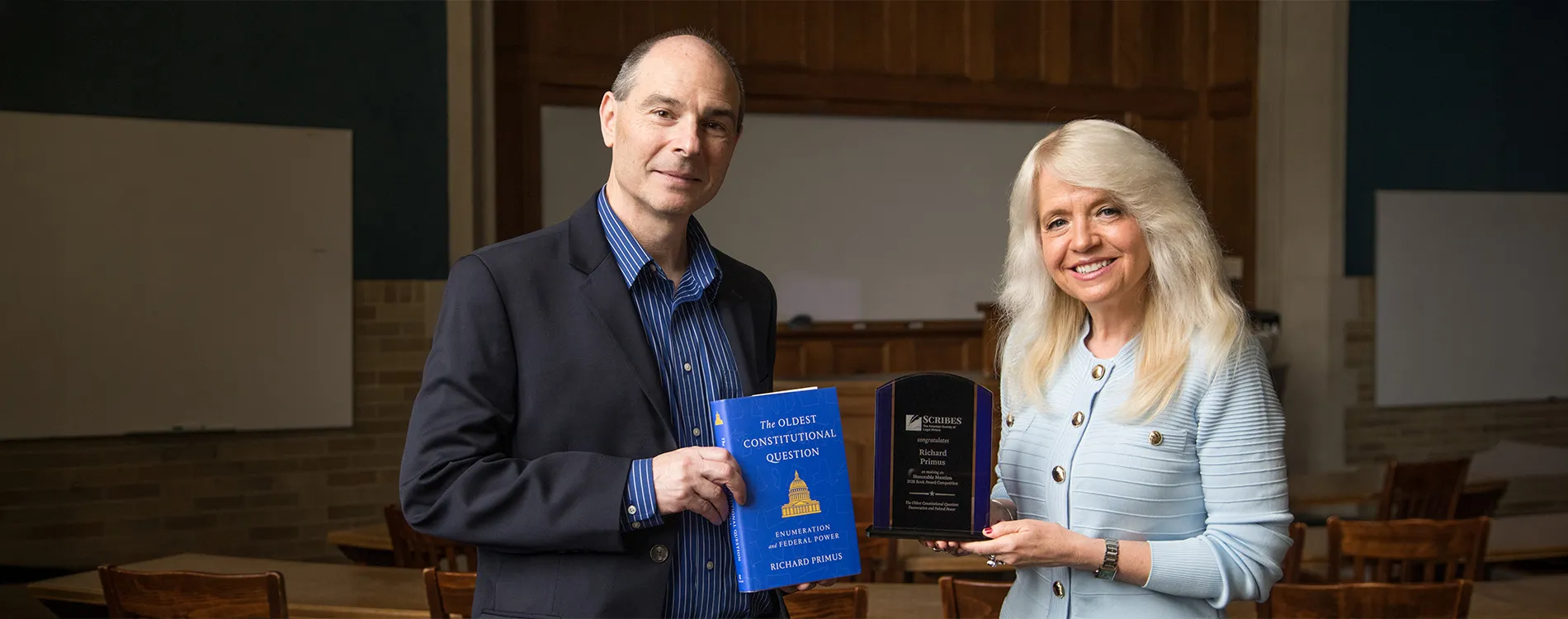
Professor Richard Primus’s book The Oldest Constitutional Question was named runner-up for the 2026 Scribes Book Award.
Scribes—the American Society of Legal Writers—presents its annual Book Award to recognize the best work of legal scholarship.
The Oldest Constitutional Question: Enumeration and Federal Power (Harvard University Press, 2025) challenges the conventional wisdom on a foundational issue of US constitutional law: that the enumeration of powers in the Constitution limits the federal government to those powers. Instead, Primus argues that the main purpose of enumeration is to rule in the powers that are listed, not to rule other powers out.
This is the work of a “brilliant scholar,” said Daniel Halberstam, Eric Stein Collegiate Professor of Law, at an award presentation for Primus at Michigan Law in October. “But what makes this book Richard’s is the care with which it’s argued, the breadth of material he brings to bear, and the easy way he brings the reader along. What is more, Richard is charmingly and characteristically cautious not to overclaim, developing counterarguments for the reader at every turn.”
Primus, Theodore J. St. Antoine Collegiate Professor of Law, teaches the law, theory, and history of the US Constitution. In 2008, he won the first-ever Guggenheim Fellowship in Constitutional Studies for his work on the relationship between history and constitutional interpretation.
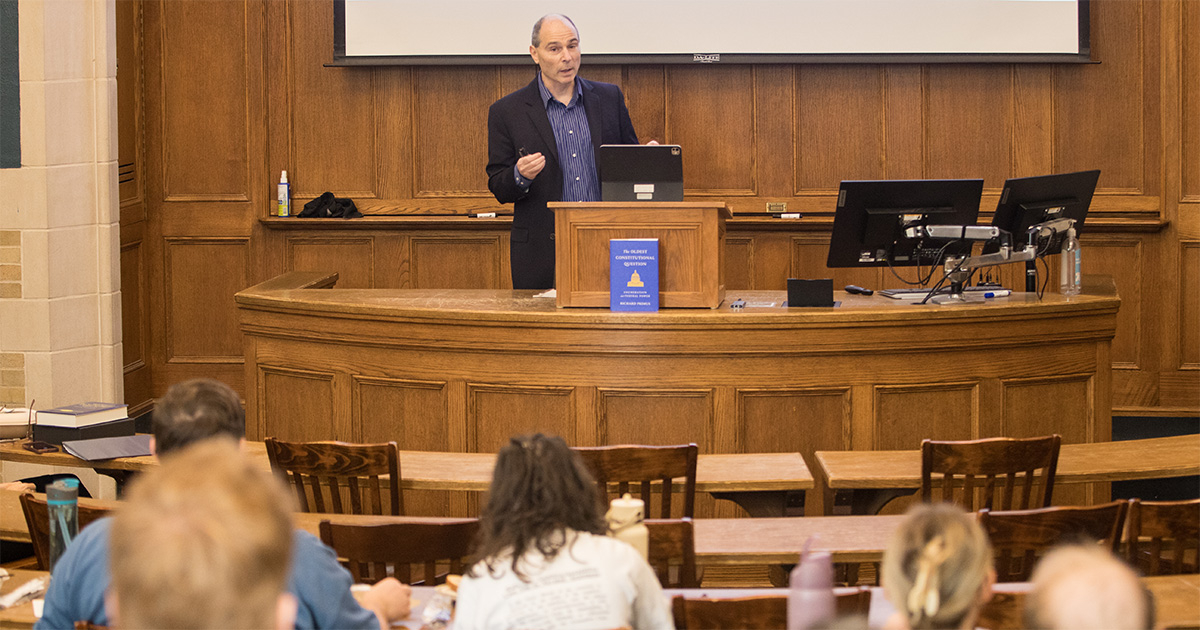
At the presentation, held in a room where Primus has taught constitutional law, he said that he has been teaching constitutional law at Michigan Law for more than two decades, and he initially accepted the conventional view that the Constitution enumerates congressional powers to limit the federal government. But over the years, he began to question that interpretation.
Although enumerationism is “generally understood as a necessary truth about the Constitution,” it is instead “a lens through which we understand constitutional law—and not the only possible lens. It’s a flawed lens that delivers the feeling but not the reality of federalism—and delivers the feeling of respecting the Constitution’s text, but it isn’t actually required by the text,” he said.
The framers chose not to say that Congress was limited to only the powers listed, Primus explained. “The framers knew that people cared a lot about how much power the new government was going to have. It was a huge issue, and many people disagreed about it. The sentence ‘Congress shall have only the powers listed here’ is not hard to write.”
Writing the book
Primus didn’t set out to write a book about enumeration, he said. But as he taught constitutional law, “It kept bothering me. One day I decided there was something in the news that was relevant to a way that I’d been thinking about this in my teaching,” he said, so he wrote a four-page paper in the Michigan Law Review First Impressions online supplement.
“I thought I was done. But in the writing of those four pages, I thought, you know what? There’s a real article here,” so he wrote one and showed it to colleagues, and then it became two articles. “By the time it became three articles, I thought, okay, fine, I have to write a book, because if I’m going to persuade people of any piece of this picture, I have to persuade them of the whole big picture.”
Primus wrote these articles between 2012 and 2015 and then put the project on the shelf in 2016. In the next few years, he wasn’t actively writing the book, but he kept talking to colleagues about the topic and his ideas matured, which made the book better, he said.
He took his time to finish writing. “I am not a great writer. What I think I am is a patient reviser, over and over. Chapter three, I think, is the longest chapter of this book. There were 19 drafts of chapter three,” he said.
“None of my best work has ever been written alone. I got tons of feedback on this at every stage,” from both colleagues and students, he said. “Perhaps the greatest privilege of my professional life is the opportunity to work with Michigan students. Many of them helped refine the ideas presented in this book.”
While the book challenges the conventional wisdom, Primus pointed out that law students still need to know the conventional wisdom. Also, his job isn’t to teach students what he thinks about enumerationism, he said. “My job is to teach students what they need to know to participate in the practice of constitutional law and maybe also to give them the tools to question that.”
Scribes Book Award
For more than six decades, the Scribes Book Award has honored authors whose research, insight, and command of language have enriched the legal profession. Scribes is celebrating its 75th anniversary.
“For the 2026 awards, our Book Award Committee considered dozens of excellent entries, with a focus on spotlighting those works with an exceptional quality of writing and depth of research,” said Michele M. Jochner, president of Scribes and a partner at Chicago’s Schiller DuCanto & Fleck LLP, when presenting the award to Primus. “We are delighted to recognize the book authored by Professor Primus as reflecting one of the competition’s best works.”
Primus is one of two runners-up. The other is Yale Law School Professor Judith Resnik, and the first-place winner is Yale Law School Professor Akhil Reed Amar. Jochner noted that both were once Primus’s professors.
Jochner said, “We congratulate you on this distinguished honor. We are grateful for your significant contribution to legal scholarship and to legal writing.”