
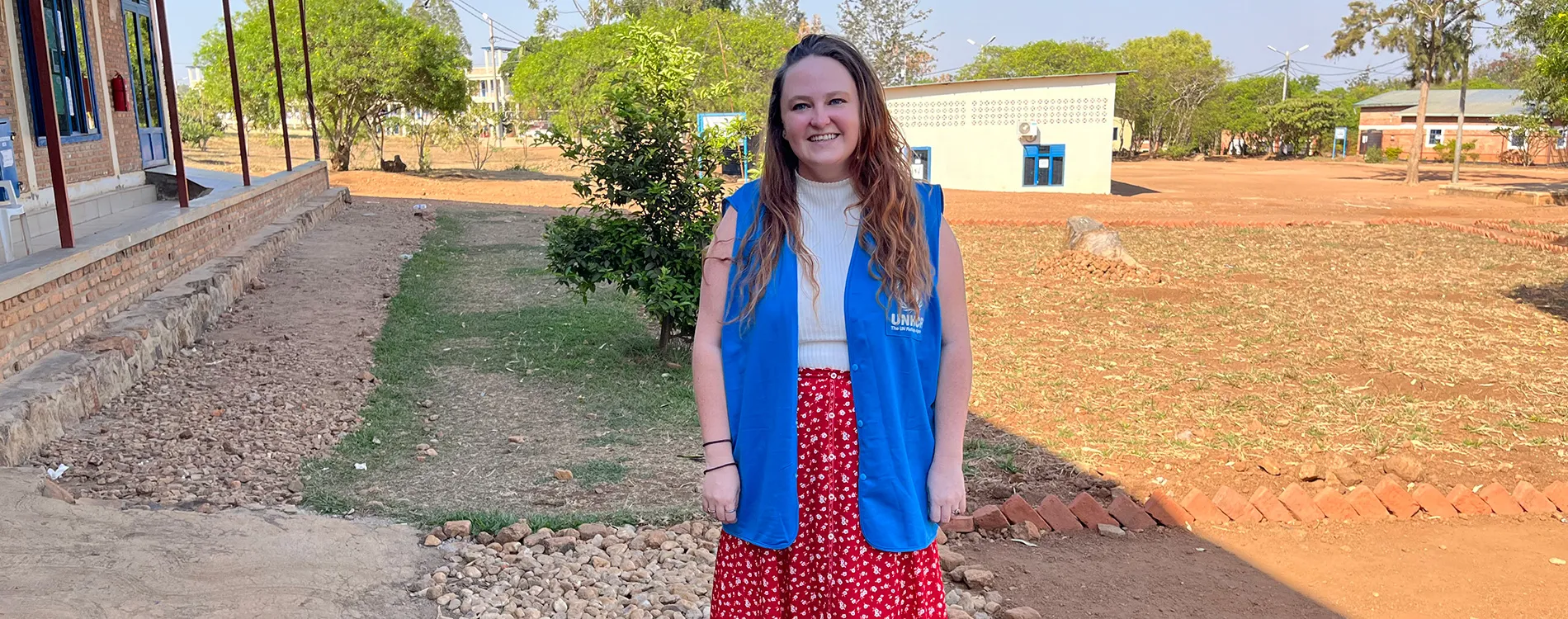
One Michigan Law alumna’s calling toward international human rights has already brought her around the globe. Her current stop? Rwanda.
As a law student, Emily Hammerslough, ’24, took every international law class she could. She also spent her 1L summer working in Namibia’s Ministry of Justice and worked during her 2L year for the International Service for Human Rights through the Law School’s semester-long Geneva Externship Program. Additionally, she attended international law conferences and served on the Michigan Journal of International Law.
“Basically, the only domestic law classes I took were the required classes during 1L,” she said. “After that, I was entirely focused on international law. Michigan Law’s international programming and connections are what made it possible for me to do the work I am doing today.”
After graduation, Hammerslough clerked for the Court of Justice of the European Union (CJEU) through the Dean Acheson Legal Stage program at the US Embassy in Luxembourg.
She recently spoke with Michigan Law about her work beyond the clerkship.
Since your clerkship with the CJEU ended, what international human rights work have you done and where?
I went back to my home state of Florida and took the bar exam. Then, I clerked at the African Court on Human and Peoples’ Rights (AfCHPR) for three months in Arusha, Tanzania. Last November, I started working at the UN High Commissioner for Refugees (UNHCR) in Kigali, Rwanda, and I’ve been here since.
What did you take away from your time working on the AfCHPR?
The internship showed me what a newer court and international body looks like. I went into the internship wanting as much comparative experience as possible [to my previous work] and to see how different systems deal with human rights depending on their respective contexts and geographic history. It was eye-opening.
How did you get involved with the UNHCR, and what have you worked on while there?
Before my last year at Michigan Law, someone at UNHCR reached out to the Law School’s Center for International and Comparative Law (CICL) looking for a fellow. I was lucky enough to interview and get the job. I’m so happy because it really is such a different experience, and it added to my overall knowledge of human rights law in different arenas.
Lately, I’ve been conducting resettlement interviews at the Emergency Transit Mechanism Centre, which is a facility in Rwanda where refugees from Libya come to facilitate their expedited resettlement to various countries, like Sweden or Canada. I’ve also done extensive refugee status determination interviews, which have helped my client-facing skills.
What do you hope to do next?
My focus has narrowed over time, particularly in wanting to work preventatively—before people have to flee, before conflict has broken out, and when there are still warning signs. I’d like to be involved in peacebuilding, conflict prevention, and grassroots empowerment so that people don’t have to seek asylum. However, there is not a single role in the international human rights field that I wouldn’t be passionate about and wouldn’t love to do, given the chance.