
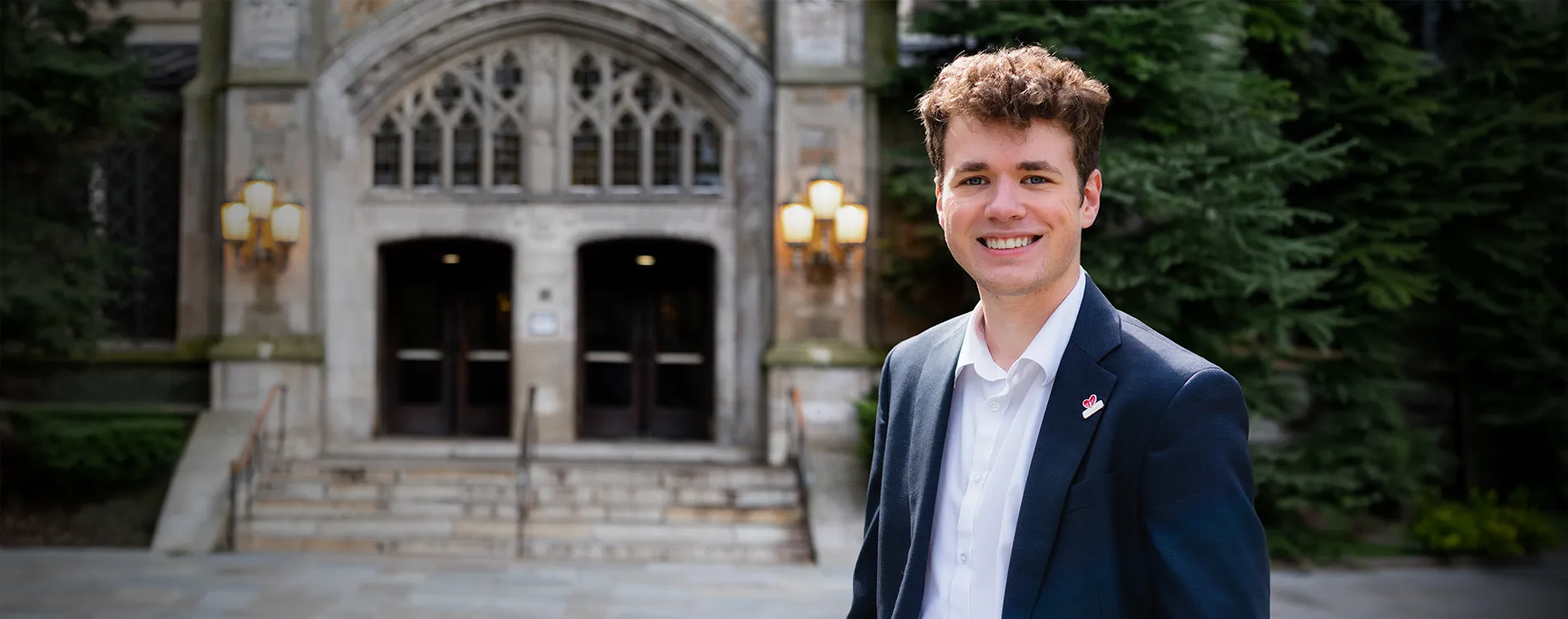
Case Thomason, ’26, received the Law School’s 2026 Paul R. Dimond Prize for his scholarly writing on how design-based bans, rather than content-based bans, are the future of social media regulation.
His paper, “Scalpels, Not Hatchets: Beyond Access Bans and Toward a Design-Based Framework for Social Media Regulation,” examines repeated attempts by states across the US to regulate social media for minors, and how nearly every proposed piece of legislation has been struck down in federal court before taking effect.
“The problem is structural, in that lawmakers have been using hatchets rather than scalpels to address this issue,” Thomason wrote.
Hatchets, as he stated in his paper, are sweeping, access-based restrictions that condition minors’ access to platforms on age verification or parental consent. Scalpels, he contrasted, are precise, design-based regulations that target specific platform features, such as push notifications, autoplay, infinite scroll, and engagement-optimizing algorithms.
“Though states’ hatchet-like solutions trigger strict scrutiny under the First Amendment, legislatures could avoid this outcome by enacting content-neutral regulations and targeting the actual mechanisms through which platforms cause harm,” he argued.
A sharper focus on design features
Acting as a primary vehicle for expression, community, and information, social media platforms have become a central part of modern life. Approximately 95 percent of American teenagers use social media and, along with its popularity, the technology’s negative impact on mental health continues to rise.
Thomason noted that the risk of depression and anxiety is higher for those who spend more than three hours per day on social media, according to the 2023 Surgeon General’s Advisory on Social Media and Youth Mental Health. Researchers also have found that specific platform design features—those mentioned above—can cause behavior in minors that resembles addictive use patterns, disrupted sleep, and altered neurological development.
Thomason said these negative impacts have led to a “widespread call for change.”
He noted in his paper that at the end of 2025, Australia banned social media for children under 16. The US, however, has yet to find similar success in enacting meaningful regulations on social media use.
While researching, Thomason found a court case in Florida that addressed this issue differently.
CCIA & NetChoice v. Uthmeier challenged Florida’s House Bill 3, which mandates age verification and ID requirements to access certain online platforms, restricting minors’ access altogether. The case argues that Florida should focus on empowering families with education, safety tools, and stronger law enforcement in order to protect children online. The US Court of Appeals for the Eleventh Circuit stayed the injunction, concluding that the law satisfies intermediate scrutiny and allowing enforcement to proceed while litigation continues.
“I thought to myself, ‘This is it,’” said Thomason. “The problem is that the legislatures are approaching it from the wrong angle, and here is an example of how you can fix it.”
We have the tools for regulation
To further examine the impact of social media design features, particularly on young users, Thomason breaks them into two categories. The first is compulsive-use features, which are mechanisms that operate entirely beneath the content layer, exploiting neurological reward loops to sustain engagement regardless of the content. The second category is algorithmic amplification systems, which select, rank, and sequence content for individual users based on a predicted behavioral response. He argues that both categories merit regulation.
“Taking a hatchet to social media regulations through broad access bans has failed everywhere it has been attempted,” he wrote. “Using a scalpel to target the specific mechanisms that cause harm is a method that is constitutionally viable, more effective in practice, and validated by the courts that have examined the issue most closely. Legislatures that are serious about protecting children from social media’s harms have the tools to do so. They need only to use them.”
At the end of his paper, Thomason outlines a model statute for legislators, written as a design restriction rather than an access restriction so that new laws can survive the First Amendment challenges that have struck down access bans.
His interest in this topic began after he read Jonathan Haidt’s book, The Anxious Generation (Penguin Press, 2024). Thomason said his time at Michigan Law affirmed his interest, particularly through working with Professor Salomé Viljoen, who played a significant role in developing his paper.
Looking ahead, Thomason will begin a clerkship on the US District Court for the Western District of Kentucky in September.
About the Dimond Prize
The Dimond Prize, made available through the generosity of Paul R. Dimond, ’69, is awarded each year for the best scholarly work in civil rights, constitutional law, or judicial review.
Michigan Law students, graduate students, and junior faculty are eligible to submit papers, essays, articles, theses, or books for award consideration. Submissions are reviewed by a faculty committee, and winners receive a $5,000 stipend.