
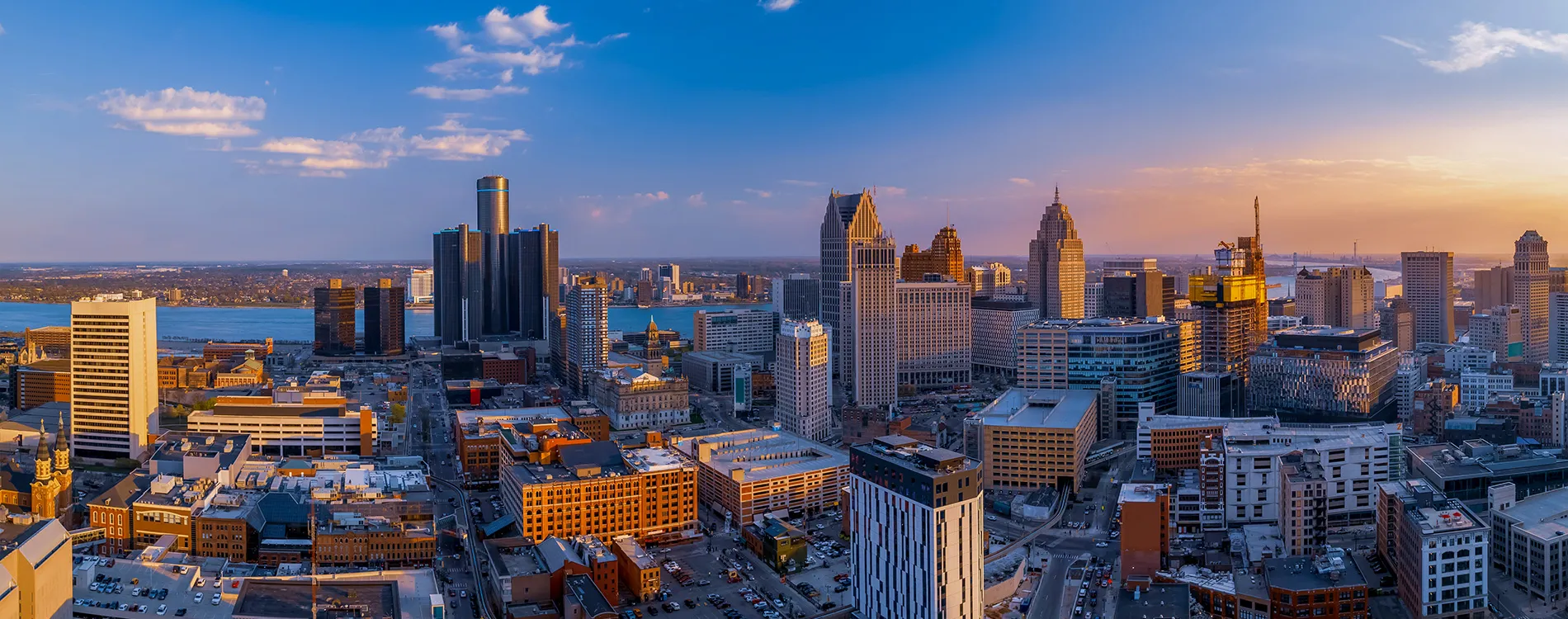
Outdated zoning laws and regulations create a major impediment to redevelopment in Detroit and other older industrial cities, according to a new research paper by Professor Noah Kazis and Michigan Law alum Brian Connolly, ’12, an assistant professor of business law at U-M’s Ross School of Business.
Their paper, “Rezoning the Rust Belt,” is forthcoming in the Washington University Law Review.
“Zoning in Rust Belt cities cements a status quo of abandonment, preventing cost-effective building designs and, on many parcels, prohibiting new development outright,” the authors wrote. Their paper explores current barriers to growth but also highlights areas where improvement is taking place and suggests additional strategies for change.
Kazis and Connolly recently answered five questions about their ideas:
1. Why are post-industrial cities left out of zoning debates, and why is that a problem for urban recovery?

Kazis: The reason land use has gotten so much national attention lately is the issue of housing affordability, which is indisputably most acute in places of high demand and low supply, like San Francisco or New York City. That’s a very big problem with national consequences, but it also means the places that are cheaper, that have emptied out, that are struggling for other reasons, aren’t part of that conversation.
Connolly: A lot of the literature on land use and planning has focused on other things about the post-industrial cities, like governance issues. A decade ago we were talking about planned shrinkage and how to make cities smaller and have less of an infrastructure footprint to serve their smaller population and tax bases.
Kazis: There’s been a sense that one set of places has this set of problems, and another set of places has that set of problems, but there’s no overlap. That’s part of where we’re trying to intervene.
2. How do rules like parking minimums and setback requirements hinder smaller developments in older cities?

Connolly: Parking is something that a developer is usually required to construct in connection with a new project. Particularly if you are dealing with a smaller piece of property, parking minimums eat into the amount of the property that you can use for a given development project, and they add cost on top of that.
Setbacks, of course, also limit the amount of property that can be used for a given development project, and they can often control the character of a project—whether it’s more suburban in character or more urban in character. When you’re thinking in terms of making revitalization possible and easing the cost burdens that developers face in these cities, those types of requirements make it all the more onerous to build.
Kazis: Parking can add as much cost as $200,000 per unit in Detroit, because it changes the whole layout of the site in a way that affects both what you can charge and what it costs to build. Removing those requirements lets you shift from a townhouse-based design to an apartment-based design, and that opens up possibilities for either cost reductions or different layouts that might be more desirable for tenants.
3. What other zoning procedures or requirements are doing more harm than good?
Kazis: Procedures are a big issue. In particular, many of these places run a lot of their development through various discretionary review processes—requiring a variance, requiring a special permit, rezoning. Because they start with fairly restrictive base rules, they’ve had a system where they say, “Okay, but we know if there’s a good project, we’ll give them an exception.”
And they mostly do that. Their goal is to get to yes, but going through the process takes time, it adds costs, it adds uncertainty, it makes it harder to get financing. A lot of these cities think they’re being quite permissive, because they do mostly grant these approvals, but they have underestimated the aggregate cost of adding these procedural steps as opposed to just allowing the thing.
Connolly: Beyond getting zoning approval, any physical development project in a city requires a building permit, and that’s really primarily intended to be a review of the building’s safety and conformance with building codes. We heard a lot in doing the interviews for this project that permitting was a particularly onerous space, particularly for larger projects.
If you’re building an apartment project, for example, after you’ve gone through the long discretionary process that Noah just spoke about, you could spend the better part of a year or more going through the permitting process, adding still more to the cost and the uncertainty.
4. What are some specific policy changes that you recommend?
Kazis: Rust Belt cities need largely the same things as cities facing really different economic situations. The zoning is too strict for reasons that are outdated. Parking requirements, single-family requirements, big lot requirements, permitting processes—these are problems whether they’re in New England or the Midwest.
Connolly: What may be different from the coasts is that these cities face significant capacity challenges, whereas cities on the coast might be better resourced. As the federal government gets more interested in land use and zoning, it should find ways to support older cities’ technology adoption or offering them funding resources to conduct planning and zoning code updates, for example.
Another issue is that these areas have sprawled quite a bit even as the center city, like Detroit, was struggling. Finding ways to limit that sprawl and encourage more of the infill development in the urban core would definitely be beneficial.
Kazis: A theme that connects a lot of our reform proposals is that it’s not about maximizing the number of units that can be built—because there’s not as much demand in these cities—it’s about reducing the cost of development so that the demand that is there actually has a path forward.
One strategy that’s gotten a lot of national coverage is this idea of pattern books, and that’s really come out of Midwestern cities. The city will come up with a catalog of pre-approved housing plans that look good, work well, fit the zoning, and have already checked all of the boxes. So as long as you say, “I’m building this pattern,” they will approve it very quickly.
5. What are some of the forces getting in the way of reforms?
Kazis: Even in places that are looking to grow, which these cities are, the politics are never easy. Someone’s worried the character of the neighborhood will change. Someone’s worried the look of the neighborhood will change. Someone’s worried this building is ugly. You’ve heard all of this in any place you’ve ever lived, and these are powerful forces. It’s hard to change.
Connolly: Also, when you’re a city that has faced decline, with decades of budget cuts, and you have significant proportions of your population that are struggling to make ends meet, you have a ton of different policy priorities. This one has probably been low on the priority list for a long time and maybe it’s crept up, but it’s probably still not at the top.