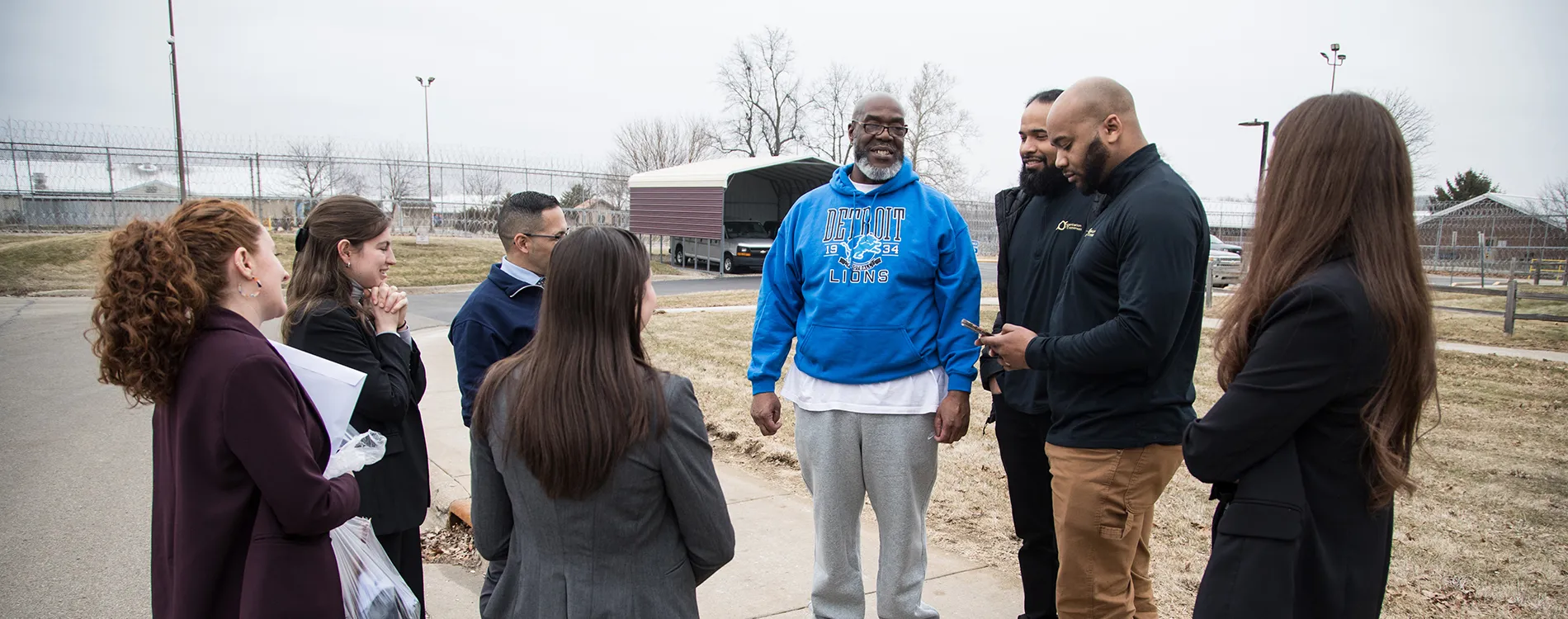
A Detroit man wrongfully convicted of murder gained his freedom this week after 27 years in prison, thanks to the work of the Michigan Innocence Clinic.
A judge vacated the conviction and dismissed the charges against George Calicut at the request of the Michigan Innocence Clinic and the Wayne County Conviction Integrity Unit, which re-examines old cases for possible unjust convictions. Calicut had been convicted of killing a relative based on a confession coerced by a retired Detroit Police detective whose history has resulted in other exonerations and lawsuit settlements against the city.
“This case is a prime example of why it is so important for our public officials to be willing to review instances of police misconduct. Mr. Calicut had never had any interaction with police prior to this case,” said Olivia Vigiletti, ’22, a clinical fellow with the Michigan Innocence Clinic and lead counsel on the case.
“A close review of this case revealed that (the investigator) not only lied to Mr. Calicut at every turn, she also coerced him into signing a statement that she wrote herself.”
A handwritten confession, written by someone else
The case began in 1999, when a woman named Virgie Perkins was killed in her home in Detroit. There were no eyewitnesses. Detectives collected various items for forensic testing, but they found no identifiable fingerprints and were unable to obtain any DNA testing results.
Several days later, the victim’s husband reported a cell phone—among other items—missing from the home. Detroit police questioned Calicut about a phone, and he admitted taking it from a truck owned by the victim’s son. The son had a history of taking phones and money from his parents’ home.
During interrogation, the Detroit police investigator authored a confession, in her own handwriting, that resulted in a murder charge against Calicut. He testified during his trial that he was innocent and that the detective coerced him into signing the statement—by telling him that it did not mean he was guilty, but rather that it would result in reduced charges and a bond that would allow him to go home.
Despite the lack of evidence, Calicut was convicted of felony murder and sentenced to life in prison without the possibility of parole. He filed various state- and federal-level appeals in the years that followed, but courts repeatedly denied relief, relying heavily on the written confession.
The Michigan Innocence Clinic gets involved
The Michigan Innocence Clinic began investigating the case in 2020. Over the years, the detective has been found in court to have coerced a number of false confessions, including two that resulted in exoneration of clinic clients—one in 2017 and another in 2022.
The clinic’s investigation found that the details of the signed confession directly conflicted with evidence at the crime scene as well as other facts of the case—such as the confession saying the killing took place at 10 a.m., while the victim’s daughter had spoken to her about an hour later than that.
In 2025, with support from the Cooley Innocence Project and the Wayne County Prosecutor’s Office Conviction Integrity Unit, a new round of DNA testing was conducted on the murder weapon as well as the victim’s purse. Calicut was excluded as a possible contributor to the interpretable portion of the results. Later, Detroit Police produced additional physical evidence that had never been tested—fingernail clippings of the victim—and Calicut was again excluded.
“One of the main lessons of this case is just how easily a false confession can be manufactured, especially when the suspect is in a vulnerable position,” Vigiletti said. “Post-conviction relief often depends on finding new evidence, and in this case, (the detective)’s well-documented history of eliciting false statements, coupled with the exculpatory DNA testing, was enough new evidence to show Mr. Calicut was wrongfully convicted.”
“His wait is finally over”
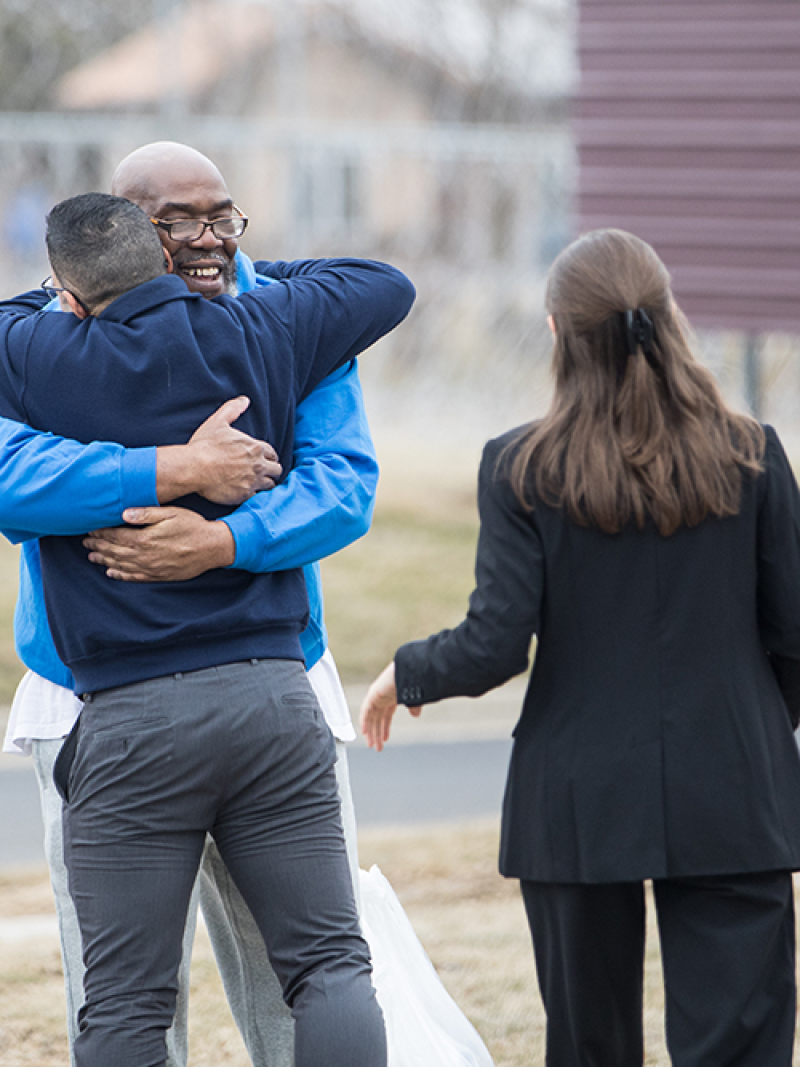
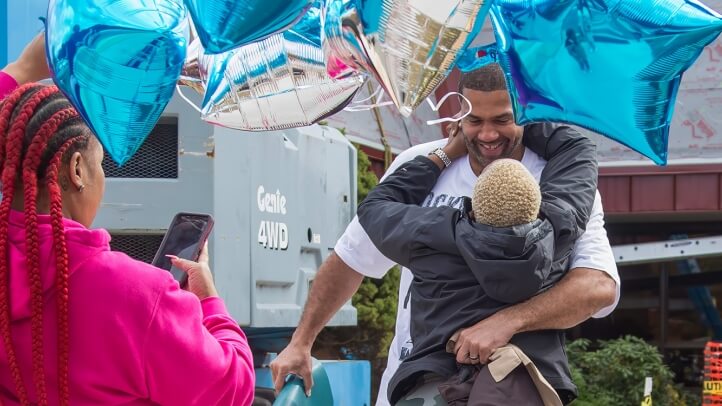
In December 2025, Wayne County Prosecutor Kym Worthy agreed that Calicut’s conviction should be overturned. He was released March 3 following a court appearance in which student-attorney Ruben Piñuelas—a 3L who is an exoneree himself—spoke on Calicut’s behalf.
“It was an honor to draw from my own experience as an exoneree to play a small role in George’s exoneration, and to bring him home,” Piñuelas said.
Elizabeth Estep, a 2L who also worked on the case, was also on hand as Calicut was released from prison in Coldwater. In total, 14 Michigan Law student-attorneys worked on Calicut’s case.
“Having been in prison for a crime he did not commit since 1999, Mr. Calicut has often reminded us that he has become an expert in patience while in prison. We couldn’t be happier for him that his wait is finally over,” Estep said. “We are so grateful to Mr. Calicut’s family and our growing freed and exonerated community here in Michigan—all of whom have come alongside Mr. Calicut to support him in his newfound life of freedom after 27 years of wrongful incarceration.”
The Michigan Innocence Clinic (MIC) is the first non-DNA innocence clinic in the country. Since its founding in 2009, the MIC has won relief in 47 cases on behalf of its wrongfully convicted clients. MIC exonerees have served anywhere from a few months to 46 years in prison.