
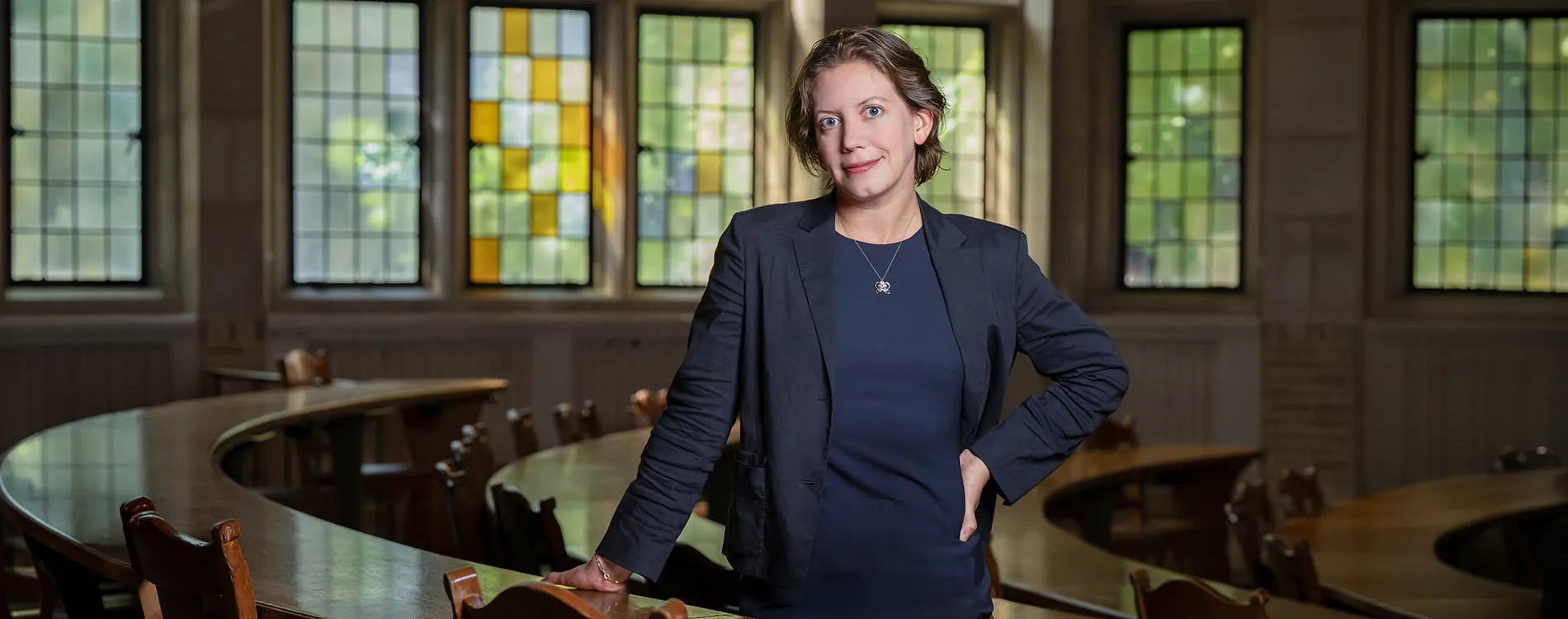
Hannah Walser came to legal academia from the world of literature, where she studied, taught, and authored a book, Writing the Mind: Social Cognition in Nineteenth-Century American Fiction (Stanford University Press, 2022).
Following her PhD at Stanford, Walser participated in the interdisciplinary Harvard Society of Fellows program. “There were a couple legal academics there, and as we got to talking, I realized that a lot of the questions that I had been trying to think through as a matter of literary history and intellectual history in the 19th century were also being explored or more practically worked through in the context of law,” she said.
Now—after earning her JD and doing postdoctoral work as a Furman Fellow at New York University Law School—Walser joins the Michigan Law faculty this fall as an assistant professor.
Law, language, and mental states
People’s mental states are one area of intellectual interest for Walser. “The law cares about mental states on a lot of different levels—for criminal culpability, for the meaning of a statute or a contract, for questions of consent,” Walser said.
“I realized that these legal fields were working through some really sophisticated understandings of the epistemic value of mental states.”
Walser is also interested in certain types of mental states “that we think of as special and that we want to protect, such as religious belief.”
As a professor, Walser’s interests include constitutional law, particularly the First Amendment, and criminal law. “Thinking about how the law understands language is an obvious extension of the kind of work I’ve done on the English side in the past,” she says. “I’ve written about statutory interpretation, and I’m also interested in how the law defines particular speech crimes. For instance, what is a threat?
“Then, criminal law is one of the substantive areas of law where mental states matter most. We use them to define degrees of culpability, which ultimately determines punishment and collateral consequences. That’s a place where the stakes of getting it right are especially high.”
Walser will teach constitutional law in the winter term, but this fall, she will teach a mini-seminar on Law and the Supernatural, which promises to “trace glimmers of the supernatural through legal history to see what they can teach us about law’s own quasi-magic powers.”
A natural move
Michigan Law appealed to Walser in part because of its strong tradition in law and the humanities.
“It’s a faculty where almost everyone seems to have some kind of rich grounding in another discipline. I feel like if you’re looking to do work that’s on an intellectual border, it’s a very hospitable place to do that,” she said.
“There are a lot of faculty here whose work I have been following and citing for years, so that’s always very exciting. The students also strike me as really sharp and lovely and engaged.”
Moving to Michigan also marks a return to the Great Lakes region for Walser, who grew up in Illinois and Wisconsin. “I really love this region, and I haven’t lived here for a long time, but as soon as I came to Ann Arbor, I felt very comfortable, very at home,” she said. “It’s the kind of place I’d be happy to settle down in for a long time.”
She’s also happy to get back to teaching after several years away. “It’s something I love,” she said.
“I can’t wait to get integrated into the teaching life, the pedagogy of the Law School. I love the idea that I will get to follow cohorts of students through the experience.”