
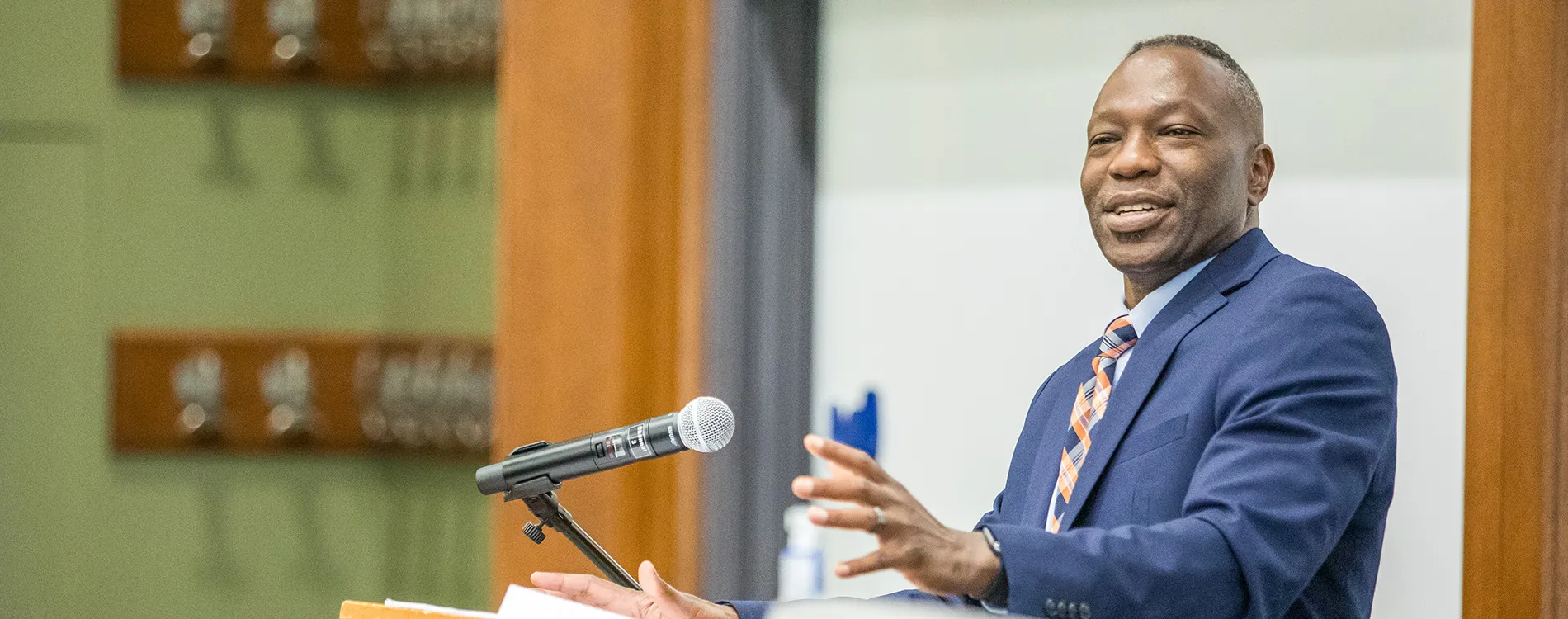
During the recent commemoration of Constitution Day, Harvard Law School Professor Guy-Uriel Charles, ’97, returned to Michigan Law to discuss the impact of the Supreme Court’s 6-3 decision in Louisiana v. Callais earlier this year.
Callais marks the end of the Voting Rights Act, Charles said. “In my view, Callais is the most significant voting rights decision of our time.”
Guy-Uriel Charles is the Charles J. Ogletree Jr. Professor of Law at Harvard Law School, as well as deputy dean. He also is faculty director of the Charles Hamilton Houston Institute for Race and Justice.
When Louisiana redrew its congressional districts to add a majority-Black district, the Supreme Court held in Callais that it was an unconstitutional racial gerrymander.
The Callais decision is part of the Supreme Court’s broader efforts to unravel the Voting Rights Act (VRA), Charles said. “It eliminated the act’s last meaningful mechanism for protecting voters of color, and it ensured that henceforth, the VRA will no longer function as an anti-discriminatory device and as an anti-majoritarian safeguard for democracy.”
Here are five takeaways from Charles’s talk.
1. This decision wasn’t really a surprise.
In a way, the demise of the Voting Rights Act is like a breakup that you knew was coming, Charles explained.
“Even though academics offered many warnings and said, ‘Hey, here are the ways to try to limit this,’ that didn’t stop the legal and political establishment from clinging to the comfort that the VRA—which many people described as the crown jewel of the civil rights movement—was a permanent fixture on the constitutional landscape in American democracy,” he said. “But of course it wasn’t and isn’t, and the court’s decision in Callais destroyed what was left of that illusion.”
2. The Supreme Court has extended its colorblindness approach from its 2023 affirmative action case to other domains.
In its Students for Fair Admissions v. Harvard decision in 2023, the Supreme Court held that race-conscious admissions programs violate the equal protection clause. Callais extends that colorblindness approach to all other domains, Charles said.
Justice Samuel Alito, writing for the Callais majority, said that race-conscious decision making by the government amounts to unconstitutional racial discrimination, which Charles called “a jujitsu redefinition of what racial discrimination means.”
3. The decision represents a regime change that views racial discrimination as a thing of the past.
The majority makes two fundamental points about race, Charles explained. One is that “what happened in the past no longer matters. Only what happens in the present does.” The other is that Congress has the power to address present-day discrimination, but “there is no present-day discrimination, and therefore Congress doesn’t have the power to address something that is nonexistent.”
In that respect, Charles said, Callais represents “a fundamental transformation of the law of racial equality.”
Historically, Charles said, “if the VRA had a core tenet or article of faith, it was the ubiquity of racial discrimination, specifically anti-Black racism in American politics. The critical implication of this article of faith was the court’s deference to Congress and Congress’s preference of choice for addressing and mitigating racial discrimination in the local process.” But now, the court is saying that anti-Black racism is no longer a significant problem in American politics.
4. As the Supreme Court has turned the page on the VRA, a new regulatory framework is needed.
The VRA was created to address some deficiencies within the constitutional structure, including that “there is no such thing in our constitutional framework as a positive constitutional right to vote,” Charles said. The government can deny people the right to vote—just not on the basis of race or sex or other specific characteristics—and the government did deny people the right to vote on the basis of literacy before the VRA.
“The VRA derived its normative, ultimately moral and legal force from its attempt to mitigate the effects of deeply entrenched historical racial exclusion,” and the Black experience served as a paradigmatic case of historical exclusion, he said. “If you view the VRA as an attempt to address what we viewed as deep institutional racism, you could also think of the VRA as functioning as a bespoke remedy to address these entrenched problems.”
However, Charles said, “to the extent that you no longer believe that the type of Jim Crow racism characterizes the voting experience, and you also view African Americans as just one among many other racial minorities that dot the American landscape, then, in a lot of respects, the VRA loses its moral force, its political force, and its historical justification.”
At the same time, the demographic composition of the United States “has changed from one in which the minority consisted of under 15 percent of the population to one in which the minority is around 40 percent of the population. Then the VRA becomes less justified as an anti-discriminatory device,” he said.
As such, the next step may be “to try to come up with a different regulatory regime that is responsive to the framework and the country that we have.”
5. The United States has made progress on racial equality in some domains but needs to address persistent racial disparities.
In the Supreme Court’s previous Shelby County decision, “the chief justice was right that things have changed, and on Constitution Day, we should celebrate the progress that we have made, particularly in entrenching formal equality and largely making a pariah of intentional discrimination,” Charles said.
“But nevertheless, what about structural inequality and existing racial disparities? Here, this leads to a less positive observation.”
One example of a persistent racial disparity is infant mortality, which has its own racial hierarchy, Charles said: the highest probability of mortality for Black infants, followed by Native American, Hispanic/Latino, Asian, and then white infants. “What does this mean for constitutional equality, and how should we address those issues?”
This is a question that law students and law schools can take up, he said. “How will we create a new civil rights consensus?” It may include universalism, or using class or partisanship as a new framework.
“In many respects, we are where we have always been, which is that our task is working to perfect the constitutional order,” Charles said. “I take that as the animating purpose of my work. How do we understand what we owe to each other as self-governing people?”
This enterprise ought to be deeply contested, Charles said. “It is about contestation and different positive visions of constitutional equality.” He added, “I learned much of that here at Michigan Law. This is the place where I started to think about these questions.”
While Callais is significant, it is only one chapter in a long book, Charles said. “This is what it means to be a people committed to the enterprise of constitutional democracy. And this, I think, is worth celebrating, particularly on Constitution Day.”