
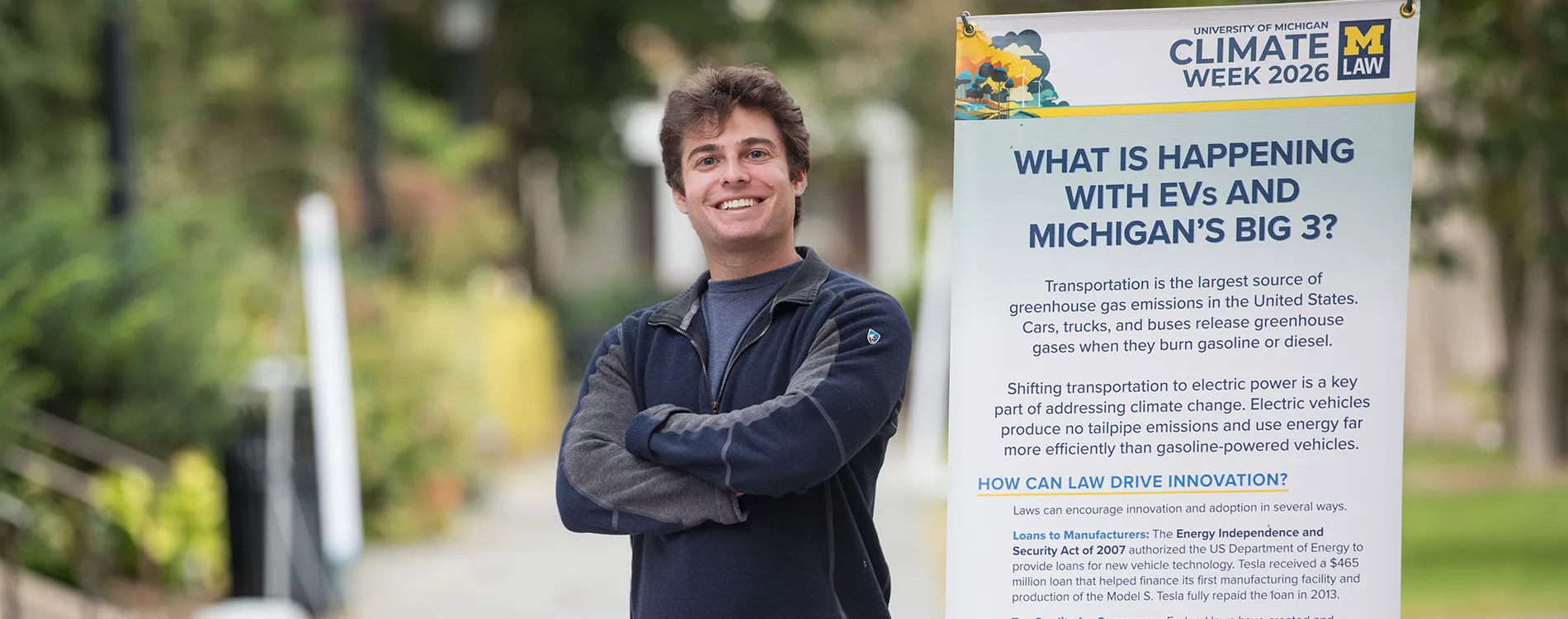
During Climate Week 2026 at the University of Michigan, which runs from September 26 to October 4, a series of exhibits placed around the Law Quad delves into how the law affects the environment and the climate. The aim is to engage Michigan Law students, undergrads, and anyone else who walks through on these issues.
The exhibits in “A Walk through Climate Law on the Law Quad” cover topics from coral reef bleaching to electric vehicles, prompted by what 3L Benjamin Korn has learned in his Environmental and Energy Law Program (EELP) courses.
“I thought Climate Week was a great opportunity to bring some of that material out of the Law School classrooms and into a more public-facing environment,” Korn said. “The law impacts everyone, and our ability to communicate it to the public is so important.”
Korn brought this idea to life with the EELP faculty’s support.
“Ben was in my Public Lands and Natural Resources Law class in the winter of 2026, and we began to talk about ways to connect our EELP Fall Conference with the University’s Climate Week,” said Alexandra Klass, James G. Degnan Professor of Law and co-director of the EELP. “Ben had lots of great ideas based on his prior work on Climate Week NYC events. We began inviting him to the EELP co-director meetings where we were discussing the Law School’s role in Climate Week, and these discussions ultimately led to Ben taking the lead on what became ‘A Walk through Climate Law on the Law Quad.’”
Korn is active with the Environmental Law Society and served as its co-chair last year. Before coming to Michigan Law, Korn worked in public relations in New York City and helped plan events for Climate Week NYC, including creating interactive exhibits. He also served as a naturalist in Aspen, Colorado, leading public tours for an environmental nonprofit. He drew on both of these experiences to create the exhibits.
Here’s what Korn shared about this project and how it took shape.
The aim
“The exhibits try to connect environmental issues with on-the-ground experience: Here’s how it actually plays out in nature.
One of the exhibits is about the American elm trees that used to stand in the Law Quad but died. Dutch elm disease has wiped out most elm trees across the country.
When something changes in the Law Quad, like the elm tree coming down last year, people notice it. And law students are naturally curious, so I’m hoping that they notice these exhibits and engage with them, and that—as they go off into their worlds—they’ll think about some of the topics discussed.
I’d love for people to connect the way policy and the law impact the natural world.
I appreciate the importance of communicating and explaining complex topics to people—and meeting people where they are.”
Why exhibits in the Law Quad?
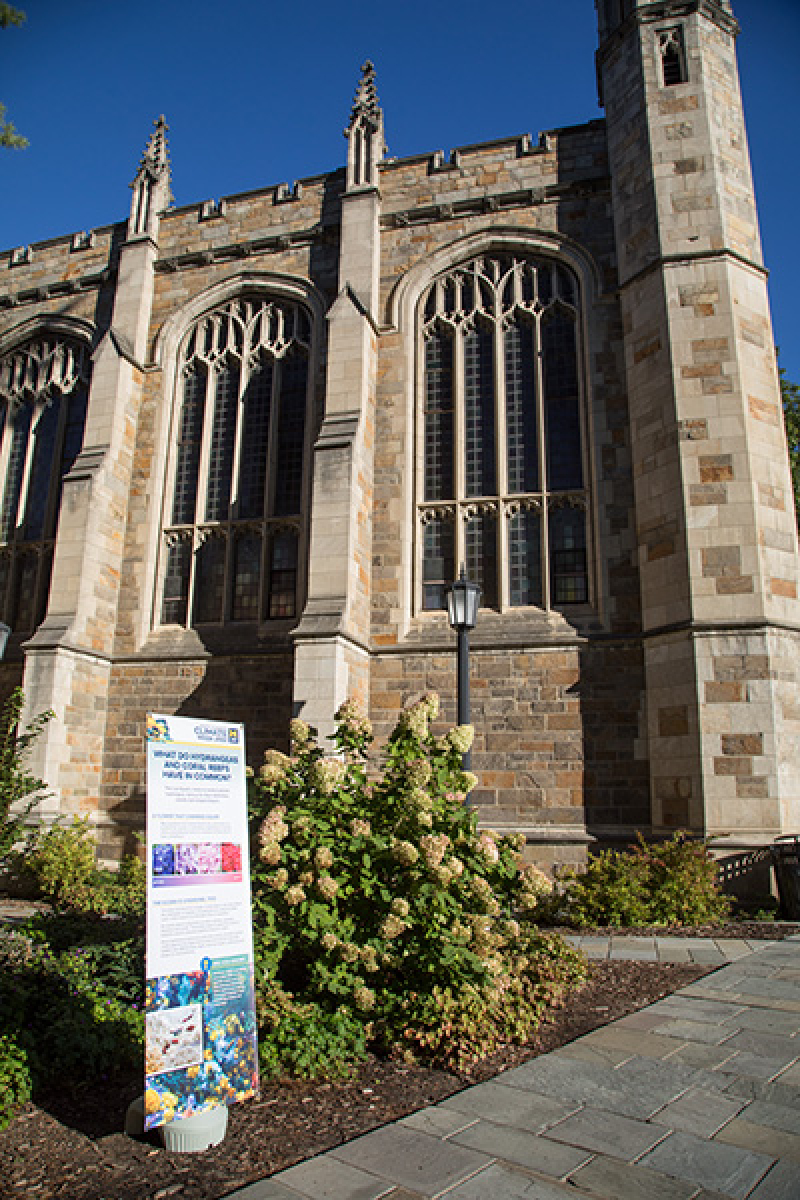
“I like the idea of using the common space of the Law Quad that people walk through every day. Along with the elm trees, another exhibit discusses the Law Quad’s hydrangeas. With the substance of the exhibits, I tried to use the setting as an accessible ‘in’ to what is often a highbrow, disconnected experience with the law.
Recently, I was able to reconnect with the natural world on a backpacking trip through old-growth forest in Vancouver with a friend who’s an arborist. He was intuiting to me, because I want to do public interest environmental law, ’You’re going to protect all this stuff.’
But sometimes the law can feel so removed.
Often the last thing I am thinking of while in Law School is a serene old-growth forest. But I look at his job being an arborist as, ‘Wow, you get to take care of the actual trees every day.’ I think that’s a very common feeling—if you’re working on the system-wide change, you feel a little disconnected from the on-the-ground impact. My goal for these exhibits is to draw that connection a little more concretely—that the law can have just as real and tangible an impact on the natural world.”
Inspired by faculty to take on a complex topic
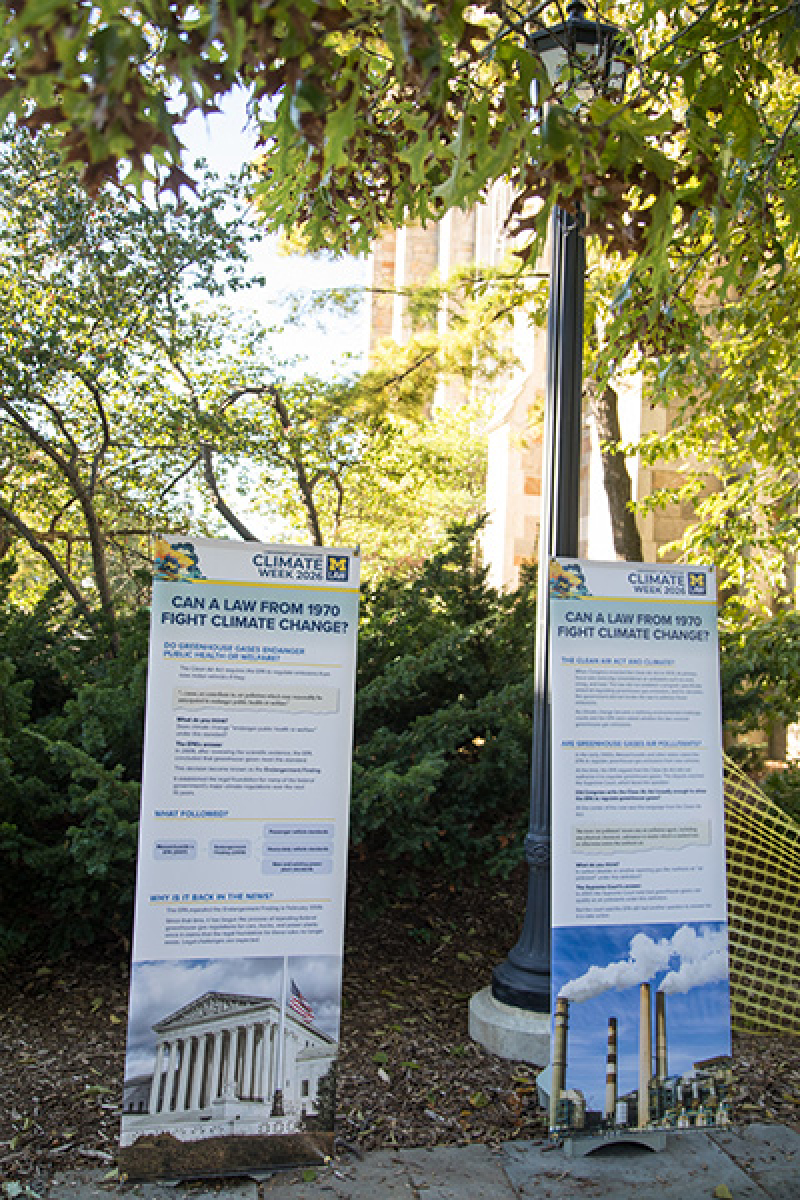
“Last year with the Environmental Law Society, we hosted a pop-up panel with EELP faculty on the EPA’s endangerment finding. This finding is an EPA determination, as well as a Supreme Court decision, that greenhouse gases can be regulated under the Clean Air Act.
This decision is huge, but the legal reasoning barely scratched the front page of the New York Times.
With my Law School professors, I’ve gotten a lot more detail. I wanted to lean in: Can we try to explain what the endangerment finding is to a general audience? It’s so important.
Earlier this month it made the news, because the EPA is using the repeal of the endangerment finding to get rid of power plant regulations. And what’s next?
The endangerment finding is complex and wonky, but I wanted to try to make it accessible. I used guiding questions, like museum exhibits do.
The exhibit pulls directly from the text of the Clean Air Act and then asks: What do you think? Does air pollutant include greenhouse gases? That’s basically the question the Supreme Court had to deal with.”
An issue that’s close to home in Michigan
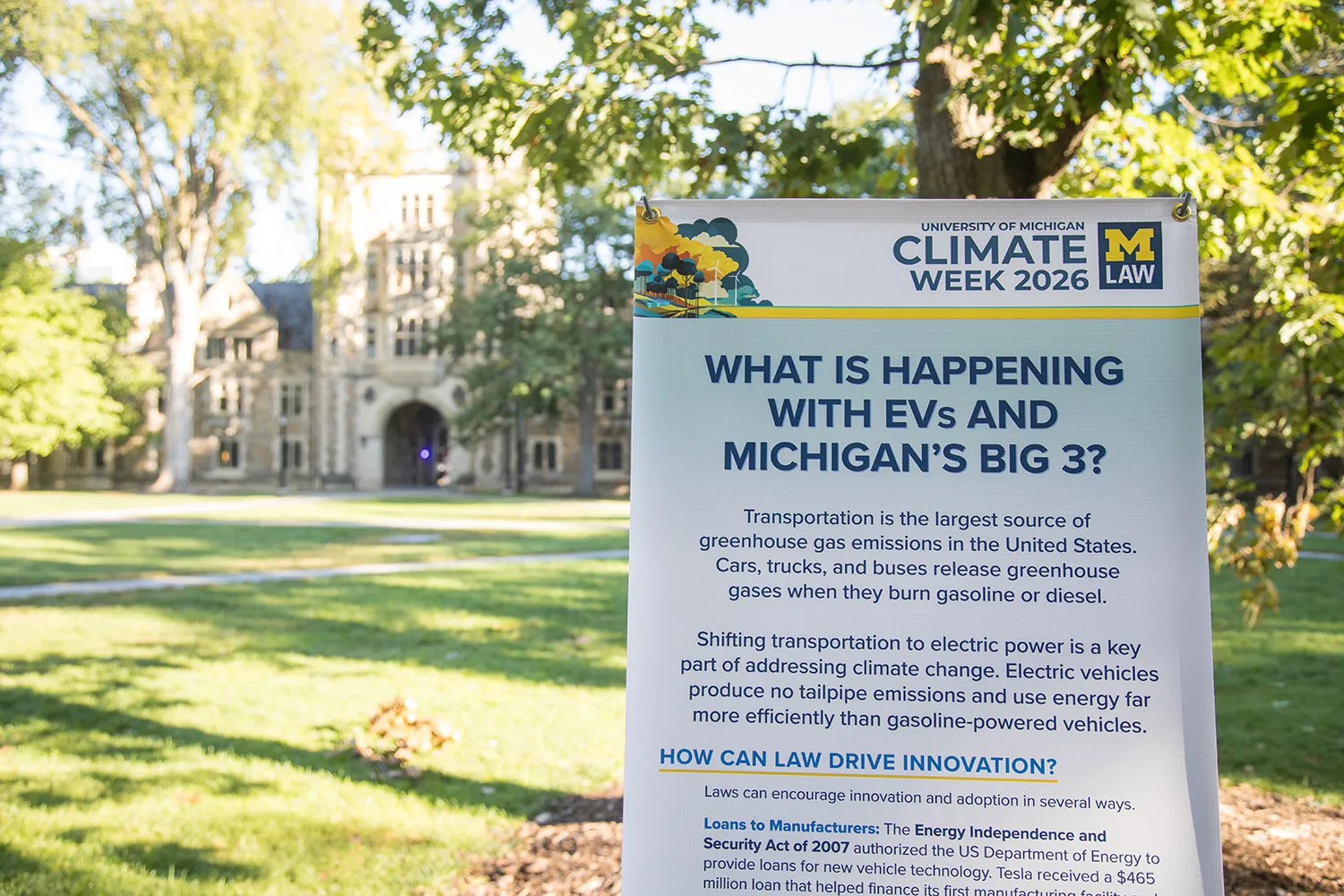
“With Michigan’s auto industry, EVs are a huge issue, but I think the layperson is wondering what the heck is happening with them.
It reflects the whiplash between administrations and how much money is being wasted because of that whiplash, how the United States is being left behind, and the importance of government in supporting markets.
Professor Alexandra Klass, who teaches energy law, helped me develop the exhibit on EVs.”
Broader conversations
“Some of these exhibits are a little more accessible, like the hydrangeas, and some are a little wonkier, like the endangerment finding, but it all creates a self-guided walking tour.
The last exhibit highlights the EELP’s October 2 conference ‘Responding to Federal Retreat: Reimagining Environmental & Energy Law in the Great Lakes Region.’ The exhibit asks: Were you interested in these topics? On Friday, we’re going to get into it and talk about them in detail, with experts being flown in from all over the country.”