

In 2014, when Quinton Jones-Whitaker was 20 years old, he was convicted of carjacking, armed robbery, and felony firearm possession and was sentenced to 12 1/2 to 22 years in prison. But he wasn’t involved in the crime, and no physical evidence linked him to it. The only evidence against him was a flawed witness identification. He had an alibi, but it wasn’t presented properly in his case. Last month, after serving his minimum sentence of 12 1/2 years, Jones-Whitaker was paroled. And on June 23, he was exonerated with the help of the Michigan Innocence Clinic.
Now 33 years old, Jones-Whitaker said, “Being exonerated changes my life by clearing my name and the mistakes they made. It allows me to actually start the life that they took from me when I was 20.”
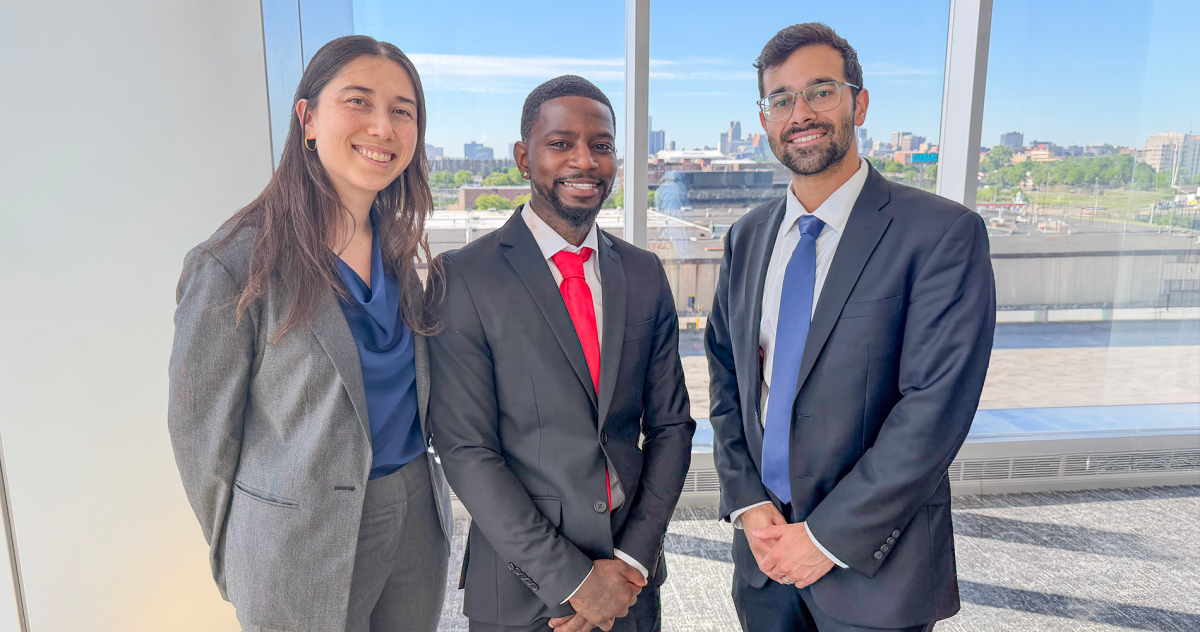
“Mr. Jones-Whitaker’s innocence was so clear to us, and we’re so happy that he’s finally home,” said rising 3L Maxime Legros. He and rising 3L Riley Segal were the two Michigan Innocence Clinic student-attorneys working on Jones-Whitaker’s case during the 2025–2026 academic year.
The wrong man and the wrong day
In June 2013, a man was carjacked and robbed at gunpoint. Someone had tricked him into showing up to a Detroit residence to meet his former girlfriend by sending messages on a texting app pretending to be her.
The victim told the Detroit police that his two assailants were about 5’10” and 160 lbs. and 6’0” and 200 lbs., and that he got a good look at only one of them. After an officer suggested the victim look on social media to identify a suspect, he found a photo of Jones-Whitaker on the former girlfriend’s Twitter page and gave it to police.
Police arrested Jones-Whitaker even though he didn’t match the victim’s description—he was 5’5” and 125 lbs. Then police presented a lineup, in which Jones-Whitaker wore a t-shirt with distinctive writing—the same one he was wearing in the photo on Twitter. The victim identified Jones-Whitaker.
“This is a case where the only evidence against the person is an eyewitness identification by a man who had just been robbed and was pretty deeply traumatized by that,” said Olivia Vigiletti, ’22, a clinical fellow with the Michigan Innocence Clinic and lead counsel on the case.
Another possible suspect emerged, but the case against Jones-Whitaker proceeded anyway. Two days before his trial, police interviewed the man who created the account used to message the victim, and he implicated a second man. But the second man wasn’t interviewed, and neither of them was charged.
“The investigation into the actual perpetrators of this crime wasn’t properly done,” Legros said. “It was a case of mistaken eyewitness identification, but it was also a case of tunnel vision and of not exploring all the other different avenues.”
Jones-Whitaker had an alibi: He was with a friend and then picked up his girlfriend. But trial counsel asked his alibi witnesses about the wrong day and time, so Jones-Whitaker effectively presented no alibi defense, Vigiletti explained.
At a post-conviction hearing, where Jones-Whitaker claimed that defense counsel failed to establish his alibi, the alibi witnesses weren’t called to the stand to provide their correct alibi testimony, even though they were in the courtroom. The court upheld his conviction in October 2015.
Uncovering new evidence
The Michigan Innocence Clinic began looking into the case in 2019. The clinic and the Wayne County Prosecutor’s Office Conviction Integrity Unit (CIU) investigated and found new evidence implicating people other than Jones-Whitaker.
They learned that two perpetrators had confessed and said that Jones-Whitaker wasn’t involved.
In 2025, the CIU requested testing for a fingerprint from the carjacked vehicle, which the police originally deemed to be unusable. Testing revealed that it belonged to a third perpetrator.
The Innocence Clinic investigated whether the three men now implicated in this crime were related. “We presented a pretty compelling case to the CIU that this was the third person and that there was absolutely no way that Mr. Jones-Whitaker was involved in this crime,” Legros said.
The CIU then interviewed the man identified by the fingerprint, who confirmed he was the cousin of the man whose texting app was used to lure the victim. “We pulled together information about who very likely actually committed the crime, which is not always something we’re able to do,” Vigiletti said.
A wrongful conviction vacated
With this new evidence, the Michigan Innocence Clinic and the CIU proposed that Jones-Whitaker’s wrongful convictions be vacated, and the Third Circuit Court, in Wayne County, agreed. This is the third exoneration achieved in 2026 through cooperation between the clinic and the CIU.
“We are incredibly grateful for the work of Val Newman and her team at the CIU in taking a second look at these cases with us,” Vigiletti said.
An order signed by the Hon. Keifer Cox on June 23 noted, “The only evidence linking Jones-Whitaker to the robbery is the victim’s identification, which is now undermined by new evidence implicating three other individuals.”
Because Jones-Whitaker was incarcerated in Michigan’s Upper Peninsula, Segal and Legros didn’t meet him in person during the clinic—they only talked with him on the phone, and they met for the first time on the day their client was exonerated.
Both returned to Michigan from their summer internships—Segal at Akin Gump Strauss Hauer & Feld in New York and Legros at Loevy and Loevy in Chicago—to represent Jones-Whitaker at his hearing.
It was important for Segal to be there with Jones-Whitaker if she could, “on a day that truly can be so life changing for him,” she said. “We are thrilled for Mr. Jones-Whitaker, and it was an honor to play a small role in helping him get justice.”
“Both Riley and Maxime really worked hard to get this case over the finish line,” Vigiletti said.
Jones-Whitaker said, “From start to finish, they have been on my side and have not let me down. I am so grateful for everyone at the clinic.”
Moving forward after exoneration
When Jones-Whitaker was released on parole in May, he knew that some of his plans—including getting a job in the auto industry—would be difficult with a felony on his record.
“When we were talking to him about what his plans are when he comes home, he said it all depends on whether he’s exonerated,” Legros said. A felony conviction complicates many things in his life, “so having this exoneration will wipe that away.”
The court’s acknowledgment of his innocence offers emotional validation, Vigiletti said. “He was so young when he got locked up. Now, he’s really thinking about his career. He wants to have a family. He wants to build his life after spending so many years in prison for a crime he didn’t commit, and getting this conviction off of his record is a critical first step to making those other things happen.”
A lasting impact on the students
Earlier this month, Jones-Whitaker visited the Michigan Innocence Clinic’s summer class.
“This was a great teaching experience for our summer students. He talked about what it was like in prison and shared that his mom filled out the application to the Innocence Clinic for him, because after losing a previous hearing, he had sort of given up. He also talked about what students can do to be really good advocates for their clients,” Vigiletti said.
Legros said the case has influenced his career. “I’ll take this for the rest of my life,” he said. “I get a lot of meaning out of this work. It means so much for our clients when somebody listens to them and believes them.” In the fall, he will return to the clinic as an advanced student-attorney.
Each year, a team of two students works on a case, so Jones-Whitaker has worked with 19 student-attorneys over the years. Along with Segal and Legros, they include: Kendal Corkle, ’20, Jonathan Kagan-Kans, ’21, Mariah Silverstein, ’21, Lauren Babbage, ’21, Adam Bean, ’22, Charlotte Boghossian, ’22, Anna Venguer Benrey, ’23, Ben Cross, ’23, Will Brodt, ’23, Alex DiLalla, ’24, Andres (“Dre”) Alvarado, ’24, Sylvia Al-Mateen, ’25, Hailey Gordon, ’25, Ayesha Qureshi, ’25, Meredith Ulle, ’25, Jonathan Church, ’25, and Richard Archer, ’26.
Legros said he learned from Jones-Whitaker’s patience with the process, especially as he faced delays in getting exonerated.
“It was really special to see the efforts of so many student-attorneys and of Quinton, his family, and the clinic all culminate,” Segal said. “This is what we’re working towards. This is the goal of every single student-attorney in the clinic.”
About the Michigan Innocence Clinic
The Michigan Innocence Clinic is the first non-DNA innocence clinic in the country. Since it was founded in 2009, the clinic has won relief in 49 cases on behalf of its wrongfully convicted clients. Michigan Innocence Clinic exonerees have served anywhere from a few months to 46 years in prison.