

When Joseph Westberry, ’24, was a child, he heard a story that inspired two primary goals for his future: to attend law school and serve in the military.
As the story goes, Mickal Sandifer, an Army corporal serving in the Vietnam War, was arrested in 1971 and confined before being tried for conspiracy to commit felony murder. He was merely a bystander to a horrific crime, yet he was wrongfully detained for several weeks until an Army judge advocate took on his case. With the attorney’s help, Sandifer was quickly proved innocent and released.
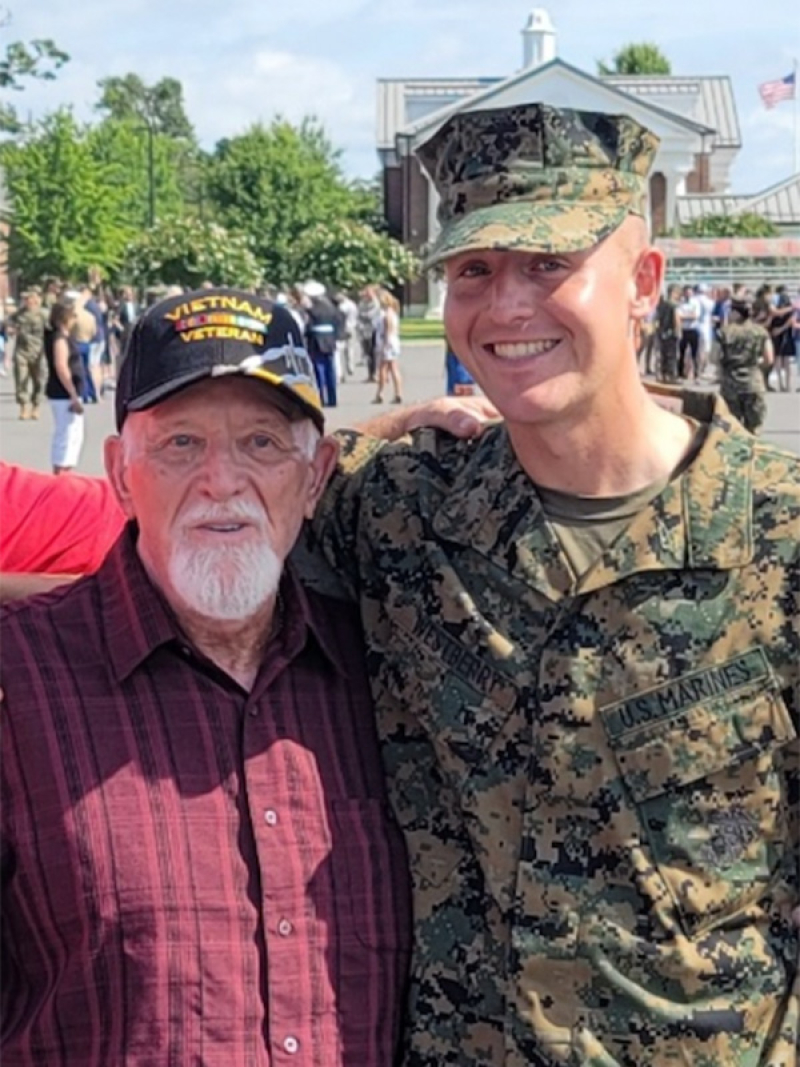
Decades later, he recounted these events to Westberry, his grandson.
Hearing the story of his grandfather’s incarceration was the first time Westberry understood what a lawyer could do. Today, he is a judge advocate himself, currently serving as a prosecutor in the US Marine Corps.
Westberry also had other family members who spent time in prison. “I grew up seeing many of the secondary and tertiary effects it can have on a family long after a sentence ends,” he said.
“That background has shaped how I approach my work as a military prosecutor and made me especially conscious that decisions within the justice system can reverberate far beyond the individual defendant.”
Prosecutors have a responsibility to exercise judgment fairly and with an appreciation for the consequences of their cases, and Westberry takes that responsibility seriously, he said.
Choosing the right law school and the right branch for him
Westberry graduated from Baylor University at just 19, then spent two years teaching and tutoring before enrolling at Michigan Law.
“I wanted to receive a serious legal education, and I knew Michigan Law was a great school,” he said. “What inspired me to commit to the Law School was its reputation for collegiality. Everyone I’d spoken to who went there talked about how much they loved it. I wanted to go somewhere I’d enjoy hanging out with people and, hopefully, make close friends. And that was the case.”
As a student, Westberry met Joshua Chinsky, a lecturer at Michigan Law and a judge advocate in the Marine Corps Reserve. Westberry took his classes on the law of armed conflict and military law and was particularly inspired by his career.
“That’s when I knew becoming a Marine was the right path for me,” said Westberry. “If you want litigation experience, there are very few better opportunities than joining the Marine Corps.”
From Michigan Law to the Marine Corps
After his 1L year at Michigan Law, Westberry completed 10 weeks of Marine Corps Officer Candidate School and was commissioned as a Marine. He asked his grandfather to issue him his first salute, a time-honored tradition marking the official transition from officer trainee to commissioned officer, which a mentor or family member in the military typically performs.
Chinsky also attended Westberry’s commissioning ceremony and gave him a silver dollar, which Westberry then gave to Sandifer—another integral part of the commissioning tradition—showing respect and gratitude to his grandfather.
“I graduated, took the bar exam, and then, two months later, I spent seven months at the Basic School doing infantry training and working to become a provisional rifle platoon commander before continuing on to my legal training,” he recalled. “I wanted to test myself in kinetic scenarios and develop my leadership skills, and the novelty of those experiences was great.”
“I’m grateful I could pursue both of my dreams, and it’s meaningful to me that a story my grandfather told me when I was a child eventually shaped the course of my life,” said Westberry. “His experience introduced me to the idea that a lawyer could step into someone’s life at an enormously consequential moment and make a difference. I’ve now had the privilege of serving as both a Marine and a lawyer myself, and I’ve seen how decisions made by lawyers and institutions can affect not only one person, but entire families for years afterward.
He continued, “Having seen some of those consequences in my own family, I feel a particular responsibility to exercise whatever authority I’m given carefully and fairly. The work has given me a much more mature understanding of justice than I had when I first heard my grandfather’s story, but the basic lesson has stayed with me: These institutions are ultimately about people, and the responsibility that comes with serving in them should be taken seriously.”