

Despite rapid change in the field of artificial intelligence (AI), Professor Patrick Barry has found that certain principles and approaches hold true—and he’s shared his insights in a new book.
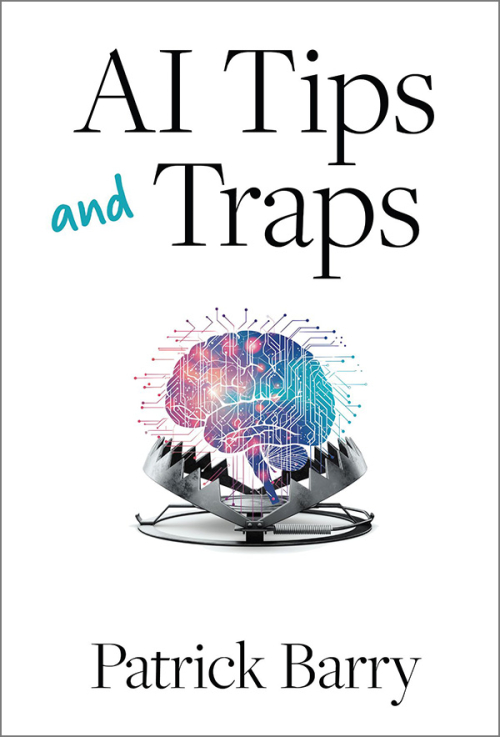
AI Tips and Traps draws largely on Barry’s experience teaching AI courses at the Law School and delivering workshops at various law firms, government agencies, and nonprofit organizations. The open-access book focuses on overarching lessons on the technology’s strengths and weaknesses, but it also includes hands-on exercises to put these lessons to work.
“Like the courses I teach, the book isn’t really designed to help you master a particular AI tool, especially because a lot of AI tools keep changing,” he said. “Instead, the book tries to provide a set of concepts and concrete strategies that can be useful as we all try to navigate a world in which artificial intelligence may play an increasingly big role in our professional and personal lives.”
Barry—director of artificial intelligence initiatives at the Law School, as well as a clinical assistant professor—recently answered five questions about the lessons in the book:
1. You say that even in the face of AI, we humans have more agency over the future than we might think. Why is that?
David Autor, a labor economist at MIT who has focused a lot of his recent research on AI, has a nice way of putting this point about agency. In an interview with a pair of journalists at Bloomberg in 2024, he suggested that the future should not be treated like a forecast. It is not a prediction exercise, like trying to guess whether it is going to rain this week or who is going to win the Super Bowl next year.
Instead, the future is a design problem. We don’t have to just wait and see what happens. We can make choices today that can help shape the world we eventually want to inhabit. I try to stress that message to my law students pretty much every chance I get.
2. You point out that there is a difference between asking an AI tool something and asking a search engine. Can you explain?
Search engines are now increasingly incorporating generative AI into how they operate, so this distinction may fade. But with traditional search engines—and even the part of Google that currently sits below its “AI Overviews”—the experience is relatively static and one directional. You receive a list of blue links that might be relevant to your initial query, and then you get to decide if you want to click on any of them to investigate further. The links themselves don’t morph or react.
The situation is different, however, with many AI tools. ChatGPT, Claude, Gemini, CoPilot, Grok, Deepseek—these and many other AI tools do morph and react. That opens up a lot of possibilities for collaboration and customization when searching for things.
But it also creates the risk that you will lose touch with the original sources and the overall informational ecosystem, especially if you rely on AI tools to summarize and interpret the material you would have previously clicked on and read yourself. There is a difference between navigating a statute, data set, or article on your own and trusting an AI tool to accurately report back after it tries to do that navigating for you.
3. Do you have a particular favorite tip from the book—one that really hits home with a lot of people?
Treat AI tools as feedback machines, not advice machines. I get uneasy when people turn to AI tools for advice, particularly with high-stakes decisions that depend on having accurate information.
But feedback doesn’t have to be accurate to still be useful. I might receive feedback from someone on a brief or contract I have drafted, and that feedback may be completely wrong about how I should fix the draft’s deficiencies. But the person’s comments can nevertheless be valuable if they help me see something about the draft I didn’t see before.
AI tools, when skillfully used, can work the same way. They can highlight blind spots in your thinking and expand your mental menu of options—sometimes precisely because they are not overly bound by a pesky thing called “the truth.”
4. On the “trap” side, what’s an example of one that is particularly dangerous?
Producing more but understanding less. I borrow that phrase from a neuroscientist at Princeton named Michelle Crockett and an anthropologist at Yale named Lisa Messeri. They raise concerns about the intellectual homogenization that might result as more and more research is done with AI.
If everyone uses AI to help them generate ideas, analyze information, and draft up their findings, we could find ourselves in a world with a lot more published papers, internal reports, and strategic memos, but a lot fewer valuable insights—especially given that many of the most creative and important breakthroughs come from nonconsensus views. That makes me nervous in terms of scientific discovery, creative thinking, and novel ways of approaching the law.
5. You close the book with a note on “play.” Why is that important?
There are a lot of things to worry about when it comes to AI. But I think balancing an informed skepticism of the technology with a mindset of experimentation and even wonder can be helpful as well, particularly when exploring new ways AI can be useful to you and your team.
If you are responsible with these tools while also being playful—and playful while also being responsible—you are probably doing something right.