
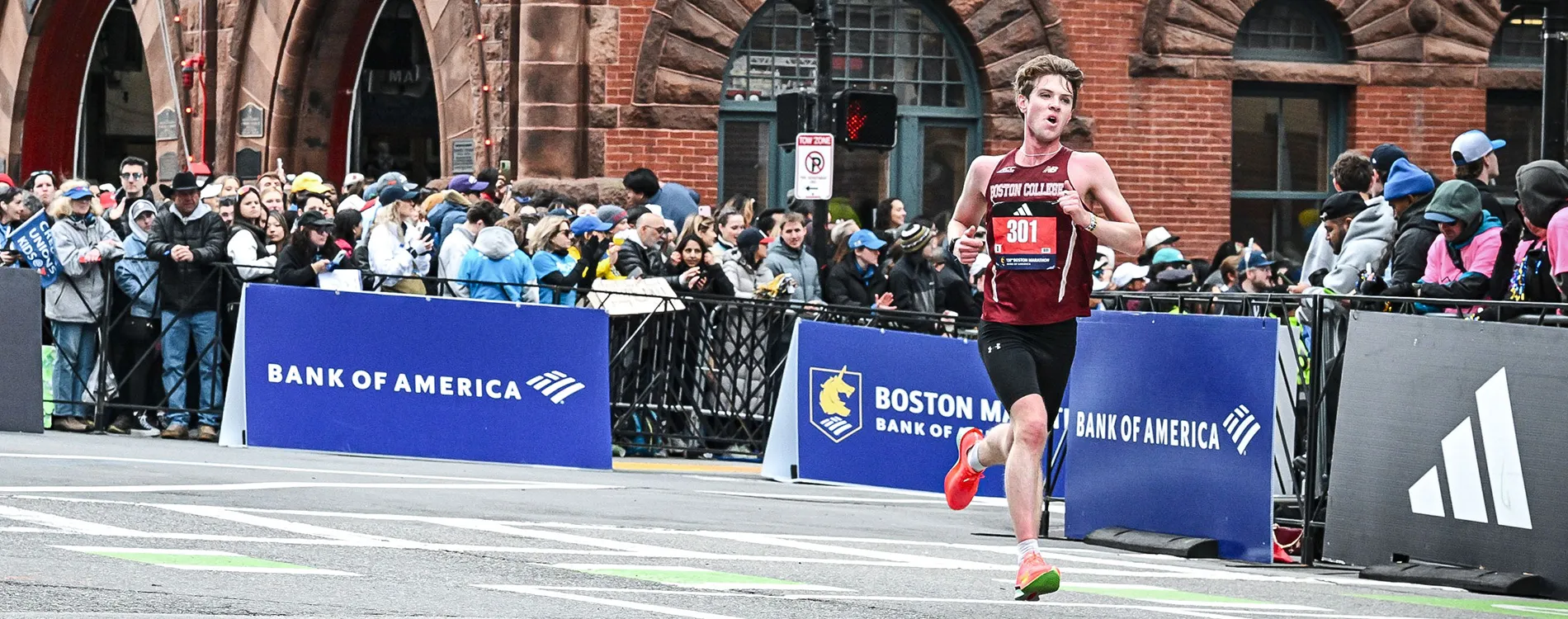
At the Boston Marathon in April, more than 29,000 runners crossed the finish line. The 69th to finish was 2L Andrew Healey.
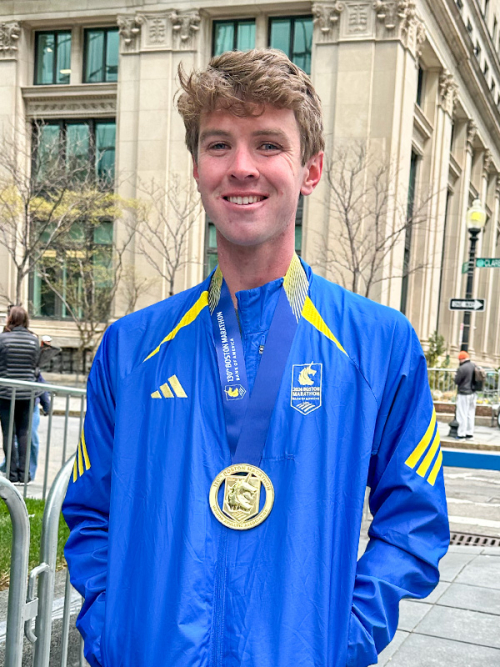
His goal was around 2 hours and 20 minutes, and he finished in 2:19:41. That’s a pace of 5 minutes and 20 seconds per mile—for 26.2 miles—on a notoriously hilly course.
Like law school, training for a marathon takes significant determination and time. But, for Healey, his training keeps him mentally sharp. “I didn’t see it as taking time away from my academics. I saw it as a necessary part of keeping myself motivated and making sure I was at my best to go to class every single day,” he said.
Healey has been running since fifth grade and competed for Boston College. But he switched from shorter track and cross-country races to the marathon distance after earning his undergraduate degree in 2024.
He ran his first marathon in Grand Rapids, Michigan, the day before his first day of classes at Michigan Law.
“I definitely underestimated how hard that race would be on me,” he said. The race didn’t go well, “and then I was like, ‘I’ve got to go to class, and I feel terrible.’” But it was a learning experience.
Healey sees some parallels between pursuing a law degree and training for a marathon. Here are some lessons he’s learned along the way.
Make time for the things that matter.
Managing both law school and high-level marathon training is challenging. Healey typically does his workouts in the morning, so he doesn’t have to worry about fitting them in later, and he treats his running as a necessary part of his schedule.
While law school requires a lot of work, “I think both mentally and as a student, you’re much better off if it doesn’t consume your entire life,” he said.
Running is a way for him to avoid thinking about school 24-7 and to clear his head.
“When I’m running, I don’t generally wear headphones or anything, so I’m just out there with my thoughts,” Healey said. When he would struggle with something in school, he found, “I would come back from a run with a fresh perspective,” even if he wasn’t thinking about the specific problem while running.
Be okay with delayed gratification.
In both law school and training for an endurance race, you have to put in the work, day in and day out, to reach a goal later on, he said. For example: “I’ve got to go do this workout today that’s not that fun, and it’s probably going to hurt really bad, but I know that three months, six months, a year down the road, it’s going to benefit me for this thing that I really want,” like qualifying for a certain race.
“For better or worse, I think law school can be the same,” and it requires perseverance and steadfastness, he said.
Don’t be afraid to push yourself out of your comfort zone.
Last fall, Healey ran the Chicago Marathon and wasn’t happy with his performance. “It would’ve been really easy to just fall back into the things I had been doing before, but I looked at myself after that and was like, ‘What could I do differently to really improve next time?’” he said. “Even though I’ve been running for years, I was like, ‘I need to make some sort of change.’”
Healey adjusted his training and his eating habits. “No matter how much of an expert you think you are, there’s always new things you can try,” he said.
Along those lines, even though Healey’s 1L year was relatively successful, he completely changed his note taking and exam preparation strategy this year, because he saw some room for improvement, he said.
Sometimes it’s best to stick with your plan even when things are going sideways.
Leading up to the Boston Marathon, Healey’s workouts indicated that his 2:20 goal time was achievable. But, at the start of the race, “the early miles are just so chaotic. There are so many people, and I found myself kind of bobbing and weaving through traffic, and it ended up a little slower than I was hoping for the first 5K or 10K,” he said.
He started to get nervous that he was falling behind his intended pace. “Even though I still had 20 more miles to run, I was already getting in my own head about, ‘Oh, I’m not going to be able to do it. This is not going to be a good day,’” he said. But then he told himself he still had plenty of time to make up the difference, and he decided, “If I can just lock in to this specific pace and this specific time, I know I’ll be okay.” And it worked.
Boston and beyond
When Healey ran for Boston College, he spent a lot of time running on the Boston Marathon course, so this race was special to him.
On race day, “the crowds are insane pretty much the whole way, but especially when you go through the schools—like Wellesley around halfway and Boston College around mile 21—it’s an energy that I can’t compare to anything else. Being on the course is unbelievably fun,” Healey said.
Healey appreciates that marathons allow him to see familiar cities differently and that they bring him to new places. In December, he plans to run the California International Marathon in Sacramento, where he hopes to run a 2:16. That time would qualify him to compete in the Olympic Trials, where the fastest marathoners in the United States will vie for a spot on the 2028 Olympic team.
Banner photo: 2L Andrew Healey running in the Boston Marathon. By sticking to his race plan amid some chaos, he met his goal of finishing the 26.2-mile course in around 2 hours and 20 minutes.
Photo credit: Boston Athletic Association, MarathonFoto